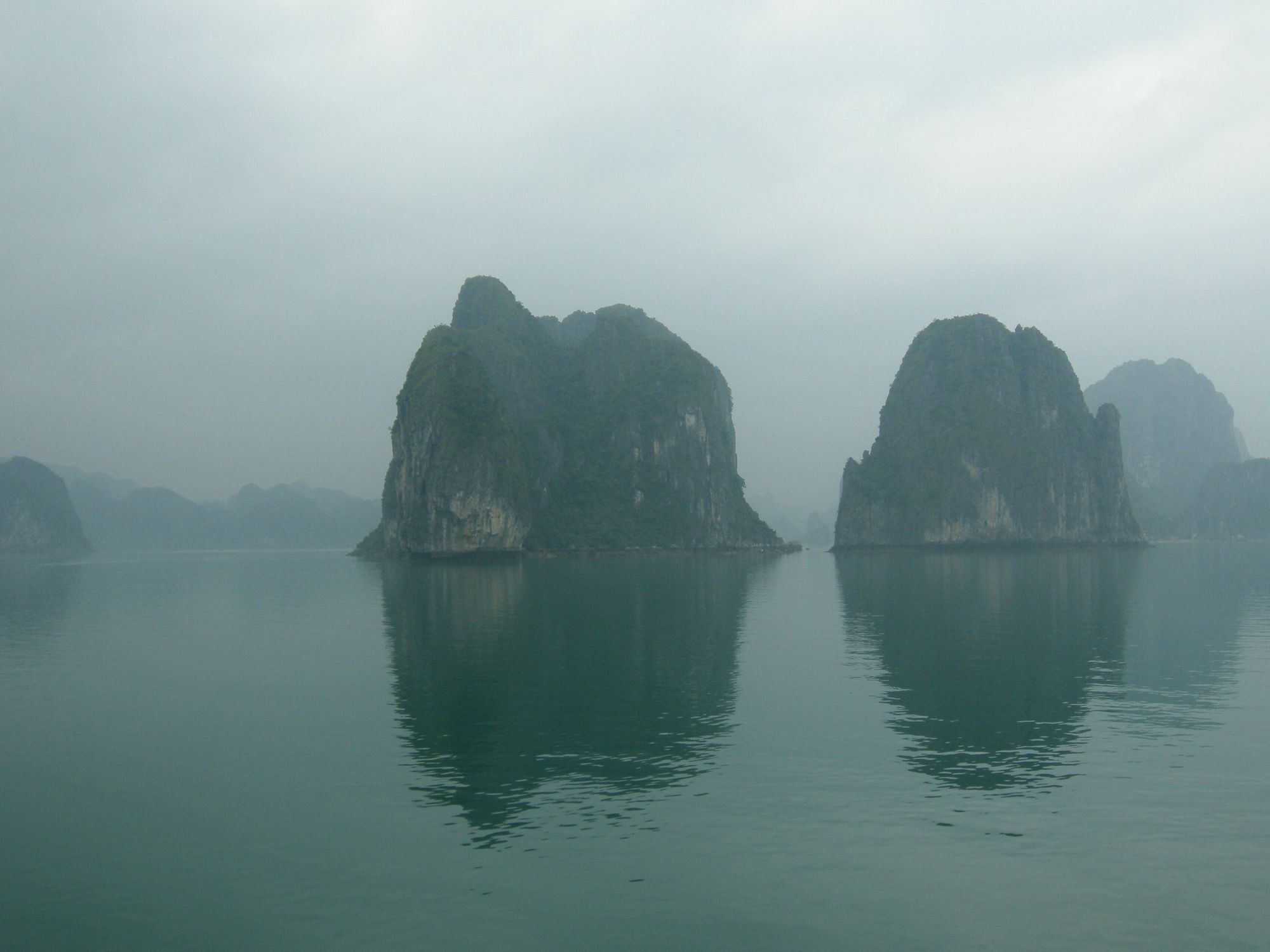
Ha Long Bay weather at a glance
Summer, from May to September, is hot and wet, with daily highs of 30 to 32°C and 183 to 431 mm of rain a month. The cooler months run from December to March, with the drizzle and mist gathered in February and March, and October and November are bright and clear.
The figures on this page are long-term averages for the Bãi Cháy (Bai Chay) weather station, on the north-western shore of the bay, from Vietnam’s national construction regulation. They describe the shore, so conditions out on open water can differ, and the regulation does not publish the exact years behind them: they run from roughly the 1960s to 2017. Sea temperatures are satellite estimates for 1991 to 2020. The packing list is at the end: see what to pack for each season.
The climate year at Bãi Cháy: air and sea temperature, then rain
| Month | Day °C | Night °C | Rain mm | Rain days | Sun hours | Humidity % | Sea °C |
|---|---|---|---|---|---|---|---|
| January | 19.3 | 14.0 | 27.7 | 7.6 | 81.2 | 80.4 | 19.7 |
| February | 19.7 | 15.2 | 24.5 | 10.4 | 48.3 | 84.0 | 19.2 |
| March | 22.0 | 17.8 | 42.9 | 14.3 | 42.9 | 87.1 | 20.1 |
| April | 26.1 | 21.5 | 86.3 | 11.4 | 88.7 | 86.5 | 22.9 |
| May | 30.1 | 24.6 | 183.2 | 12.0 | 178.2 | 83.3 | 26.9 |
| June | 31.5 | 26.0 | 297.0 | 15.5 | 168.4 | 83.8 | 29.1 |
| July | 31.7 | 26.2 | 364.3 | 16.5 | 186.8 | 83.6 | 29.6 |
| August | 31.3 | 25.4 | 430.5 | 18.7 | 165.2 | 85.6 | 29.8 |
| September | 30.7 | 24.4 | 276.0 | 14.1 | 177.1 | 82.5 | 29.4 |
| October | 28.8 | 22.2 | 142.6 | 9.2 | 177.3 | 78.5 | 27.8 |
| November | 25.5 | 18.7 | 38.9 | 5.8 | 155.7 | 76.7 | 25.4 |
| December | 21.7 | 15.3 | 18.1 | 5.2 | 127.7 | 76.3 | 22.1 |
Over the year the station averages 23.3°C, with daily highs averaging 26.5°C and lows 20.9°C, humidity of 82.4% and about 1,600 hours of sun. About 1,900 mm of rain falls on roughly 140 days. Most of it comes in a rush: June to September bring 71% of the year’s rain, and November to March only 8%. July is the hottest and sunniest month, August the wettest, December the driest, January the coolest and March the dullest, with about an hour and a half of sun a day.
The bay’s management board, the Ha Long Bay - Yen Tu World Heritage Management Board (the Board), describes two main seasons, winter from November to March and summer from May to September, with April and October as the turns between them. That is a fair summary. The four blocks used on the best time to visit page split the year a little more finely, from the same station figures.
Month by month
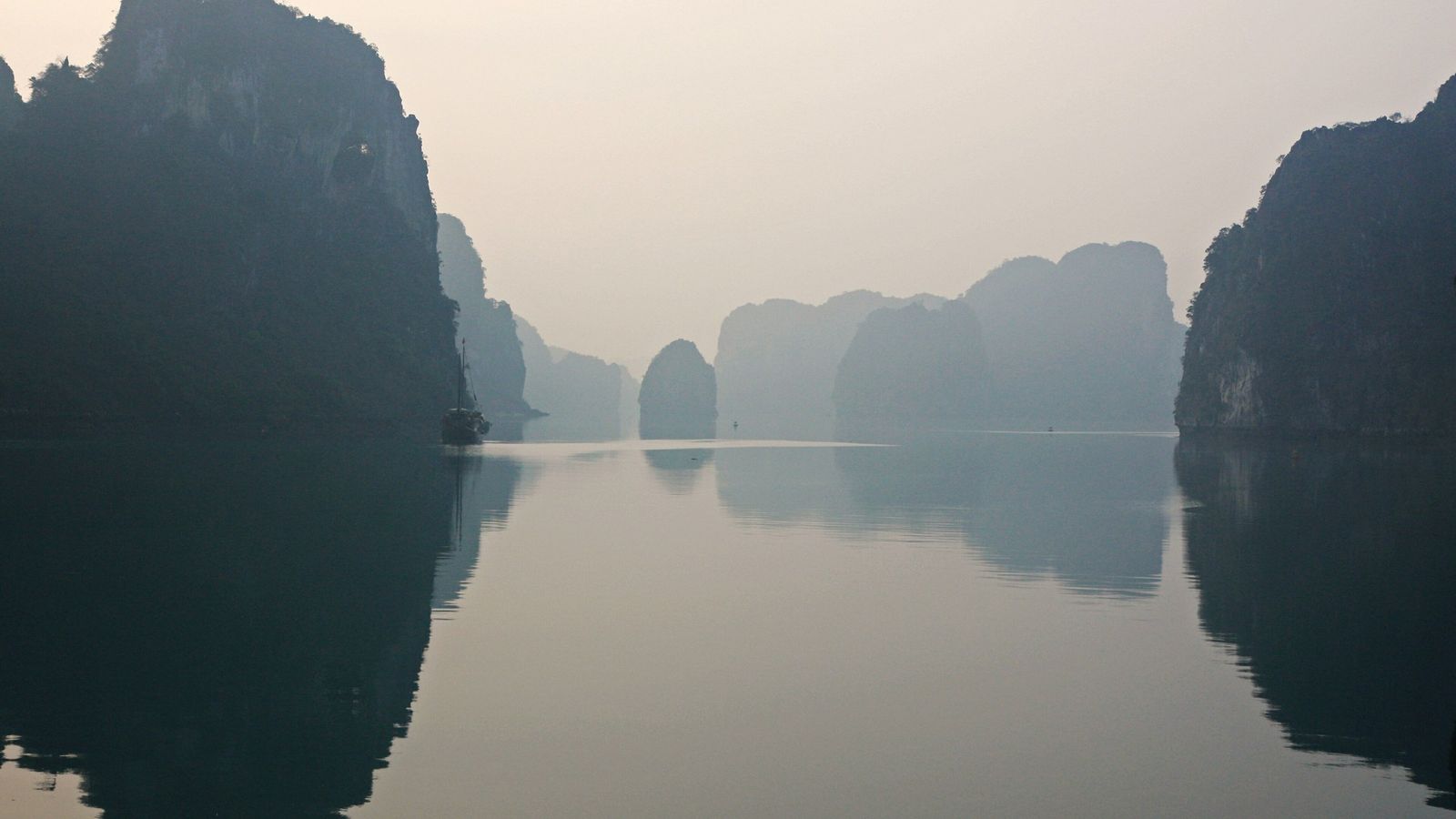
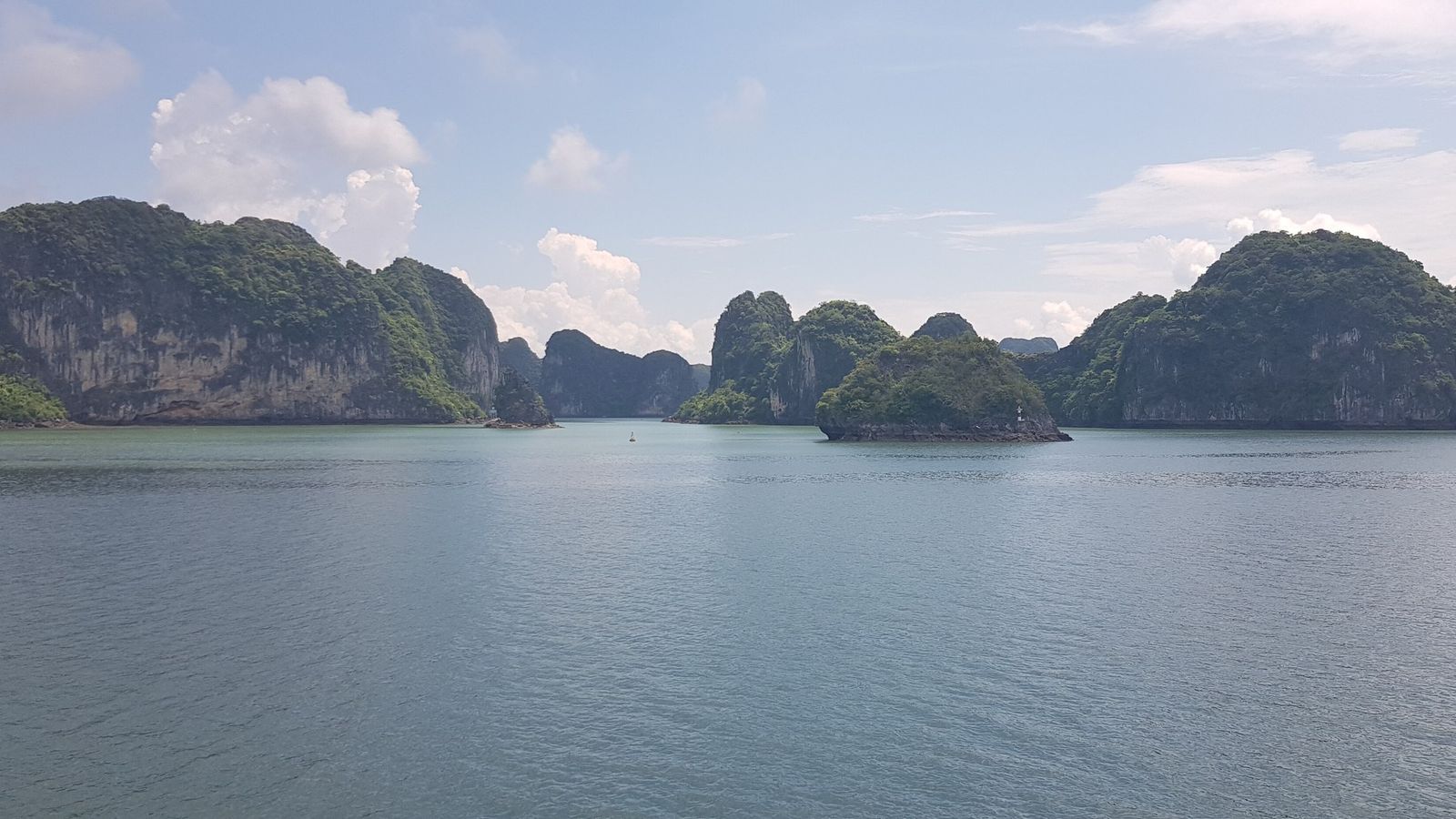
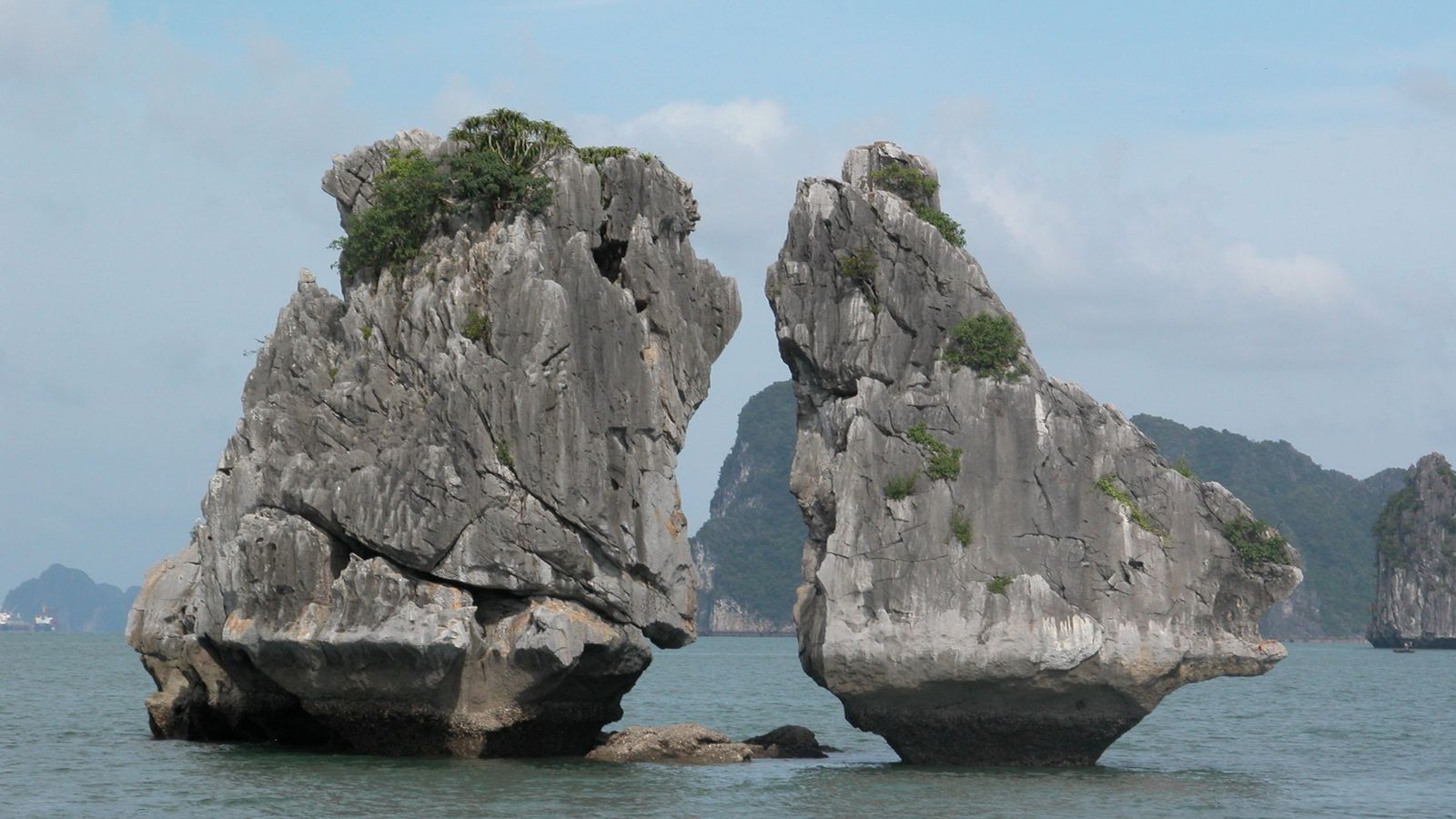
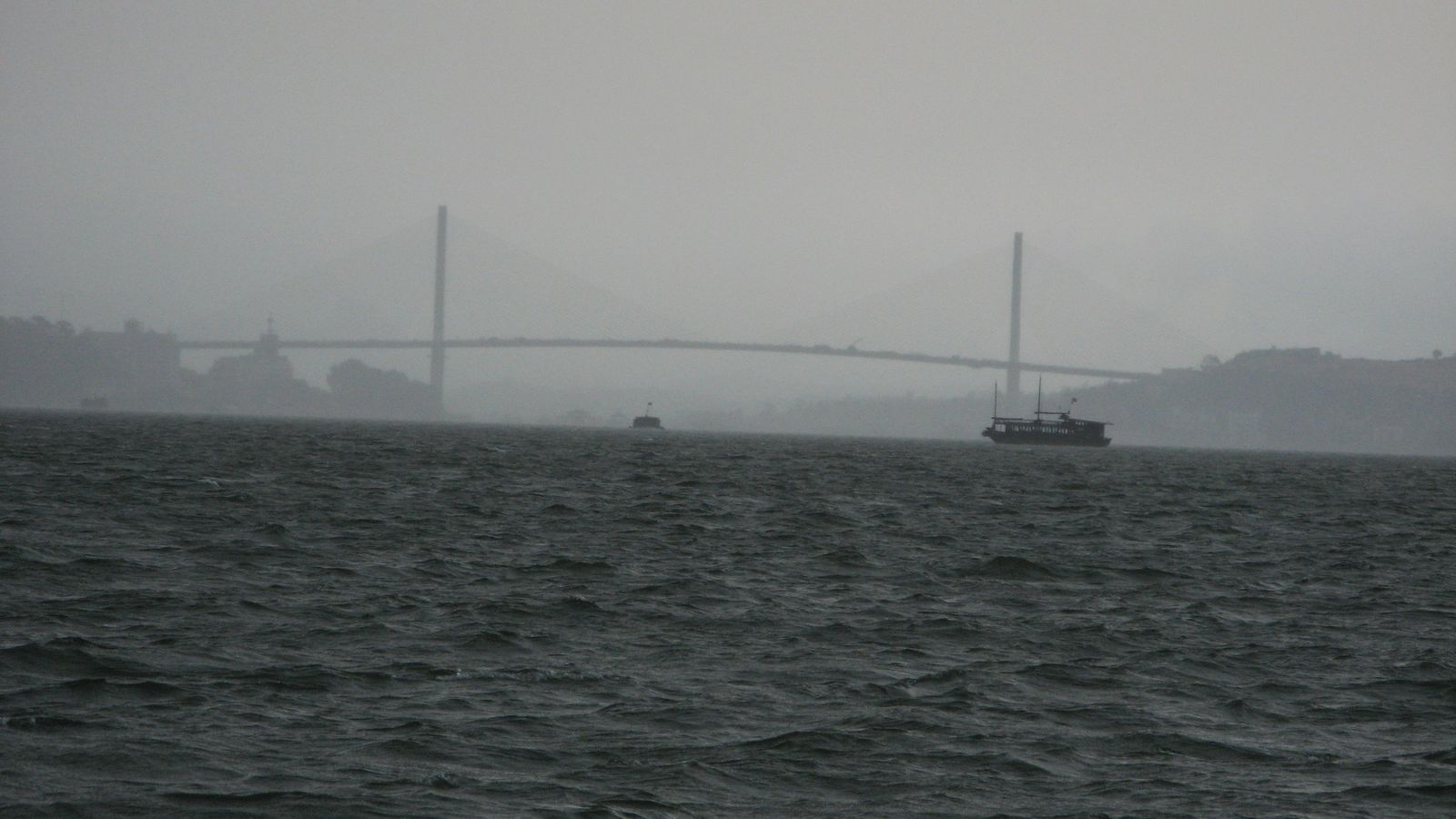
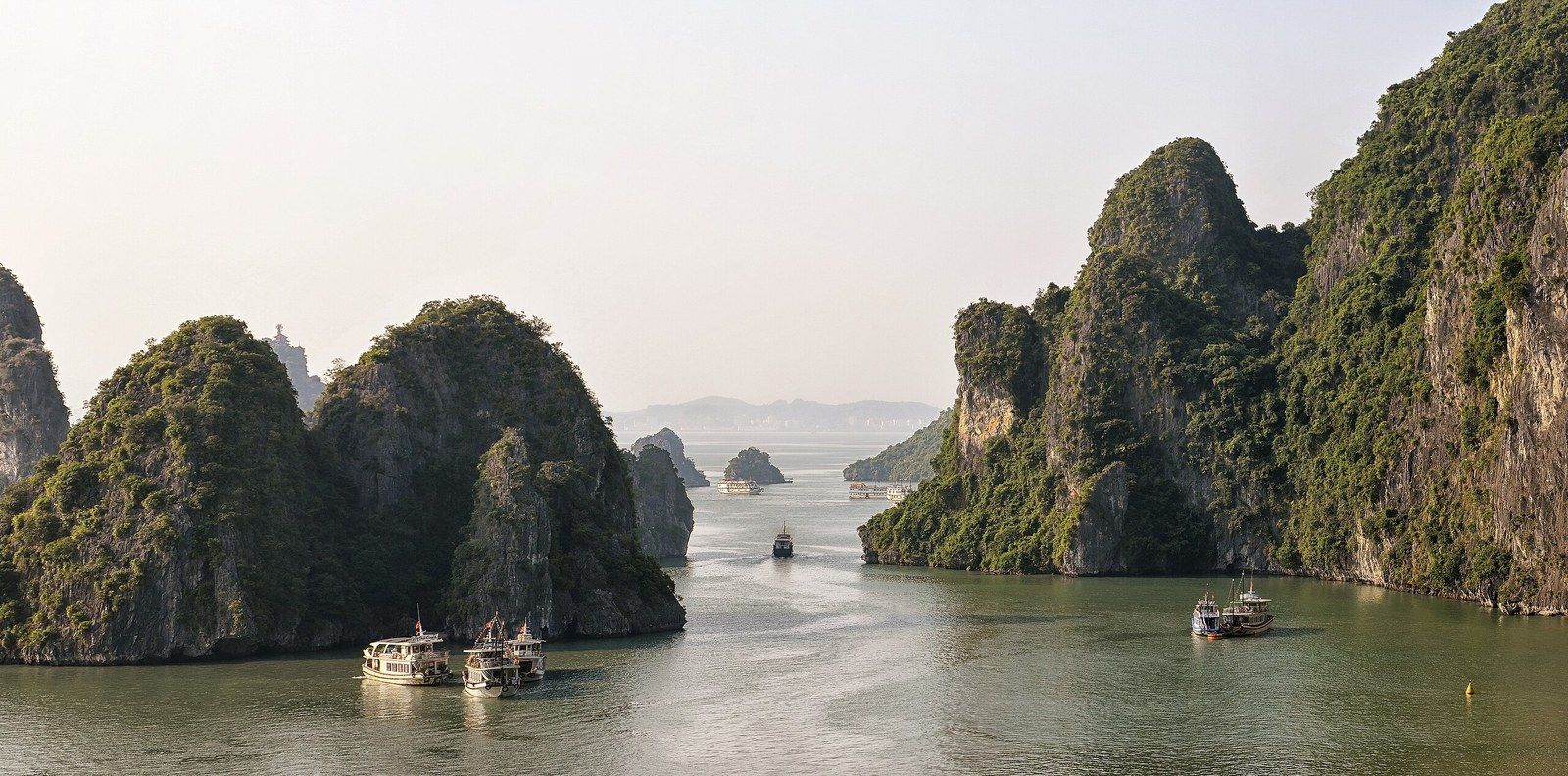
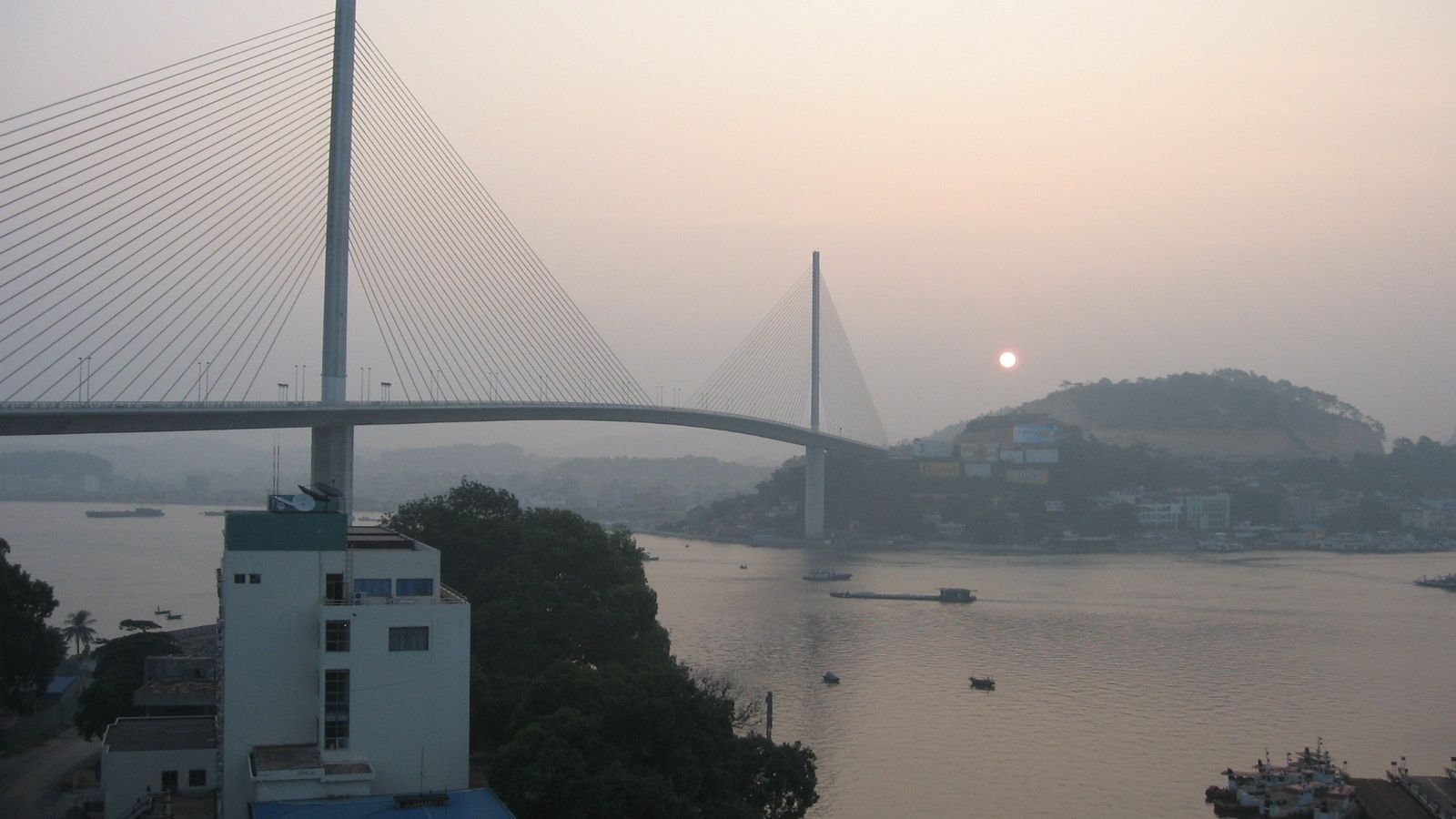
Each month below gives the station’s temperatures, rain, sun and humidity, the sea temperature, the mist and drizzle record and the storm risk, with a few lines on what the month means on a boat. The photograph for each month was taken in that month. It shows one day, so it is no forecast.
January

February

March
April
May
June
July

August
September
October
November

December

Sea temperature and swimming
The sea is coolest in February, at 19.2°C, and warmest in August, at 29.8°C. Swimming is allowed only at licensed beaches, and in 2023 Đảo Ti Tốp (Ti Top Island) had the only one operating in Ha Long Bay.
From June to September the water stays between 29.1 and 29.8°C, and May and October are warm too, at 26.9 and 27.8°C. December to April sits between 19.2 and 22.9°C. These are satellite estimates for open water 20 to 40 km outside the main tourist routes; the shallow, river-fed water inside the bay, 5 to 10 m deep on average, can run a degree or two colder in winter and warmer in high summer.
| Month | Mean °C | Coldest year °C | Warmest year °C |
|---|---|---|---|
| January | 19.7 | 17.8 | 21.2 |
| February | 19.2 | 16.8 | 21.4 |
| March | 20.1 | 17.6 | 22.3 |
| April | 22.9 | 20.7 | 25.3 |
| May | 26.9 | 25.4 | 28.6 |
| June | 29.1 | 28.0 | 30.6 |
| July | 29.6 | 28.3 | 30.9 |
| August | 29.8 | 28.6 | 30.9 |
| September | 29.4 | 28.3 | 31.0 |
| October | 27.8 | 26.3 | 28.8 |
| November | 25.4 | 23.4 | 27.3 |
| December | 22.1 | 20.8 | 24.0 |


Mist, drizzle and visibility
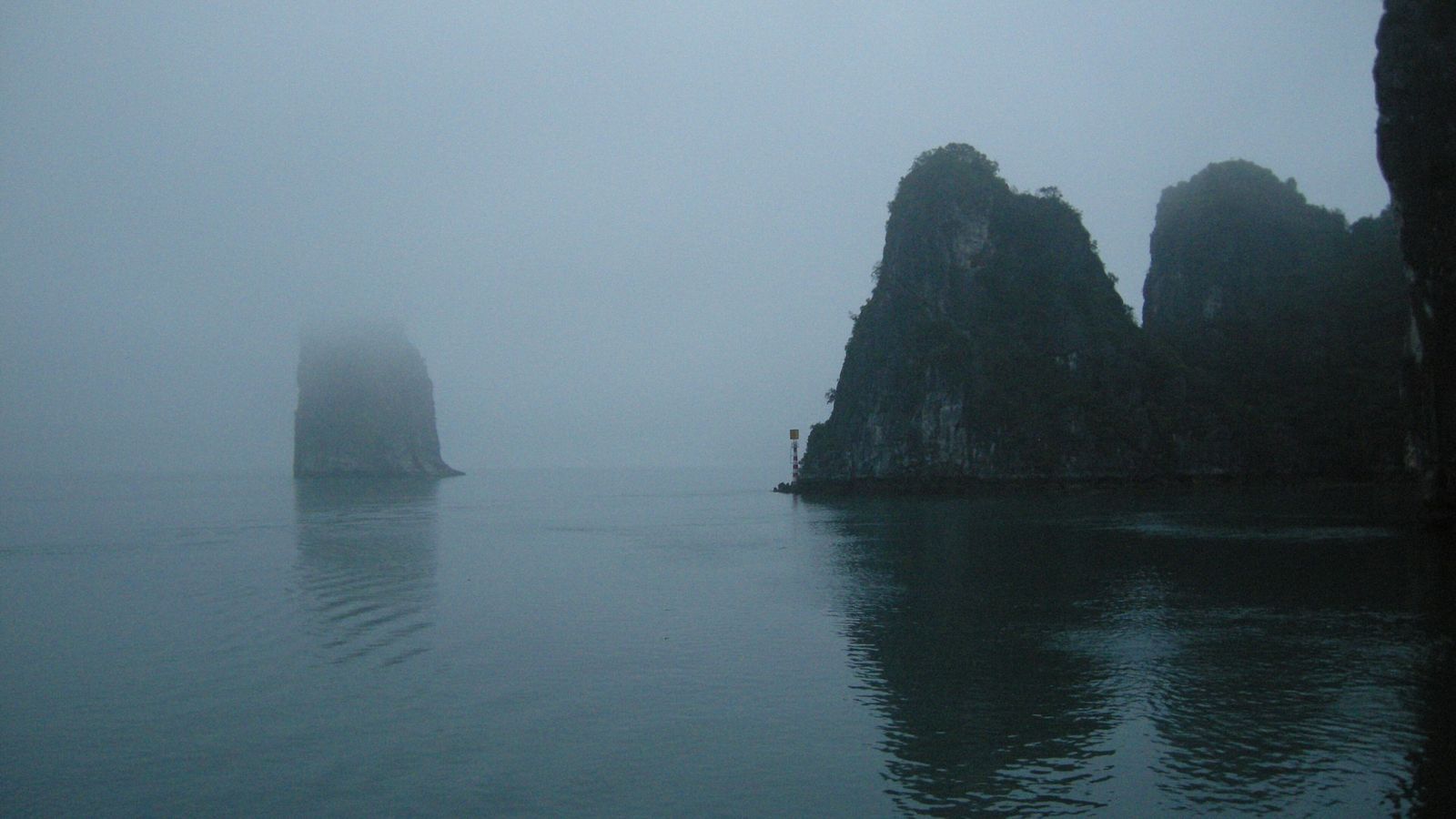
Mist and drizzle belong to February and March. The Bai Chay station records drizzle on 6.9 days in February and 9.8 in March and fog on 2.5 and 4.2 days, the sky is mostly grey, and humidity peaks at 87.1% in March.
Drizzle, mưa phùn in Vietnamese, falls on about 24 days a year at the station, and February and March hold 69% of them. January has three drizzly days and April just under four; from May to October there are none. Fog or mist is recorded on 10.9 days a year, most of them between January and April. Out on the water fog is probably more frequent than at a shore station, though no one measures it there.
In February and March the station logs 43 to 48 hours of sun a month and 10 to 14 rain days. No visibility record is published for the bay, so “poor views” in these months is a reading of the fog, drizzle and sun figures, without a measured distance behind it. No published rule stops boats for fog either: sailing notices cite storm forecasts and provincial orders. Ask the operator about fog and strong-wind days.
-
Hang Sửng Sốt A curved walkway and landing stage with sun umbrellas lie below a wooded limestone peak, with boats on pale green water in mist, seen from above at Sửng Sốt Cave.
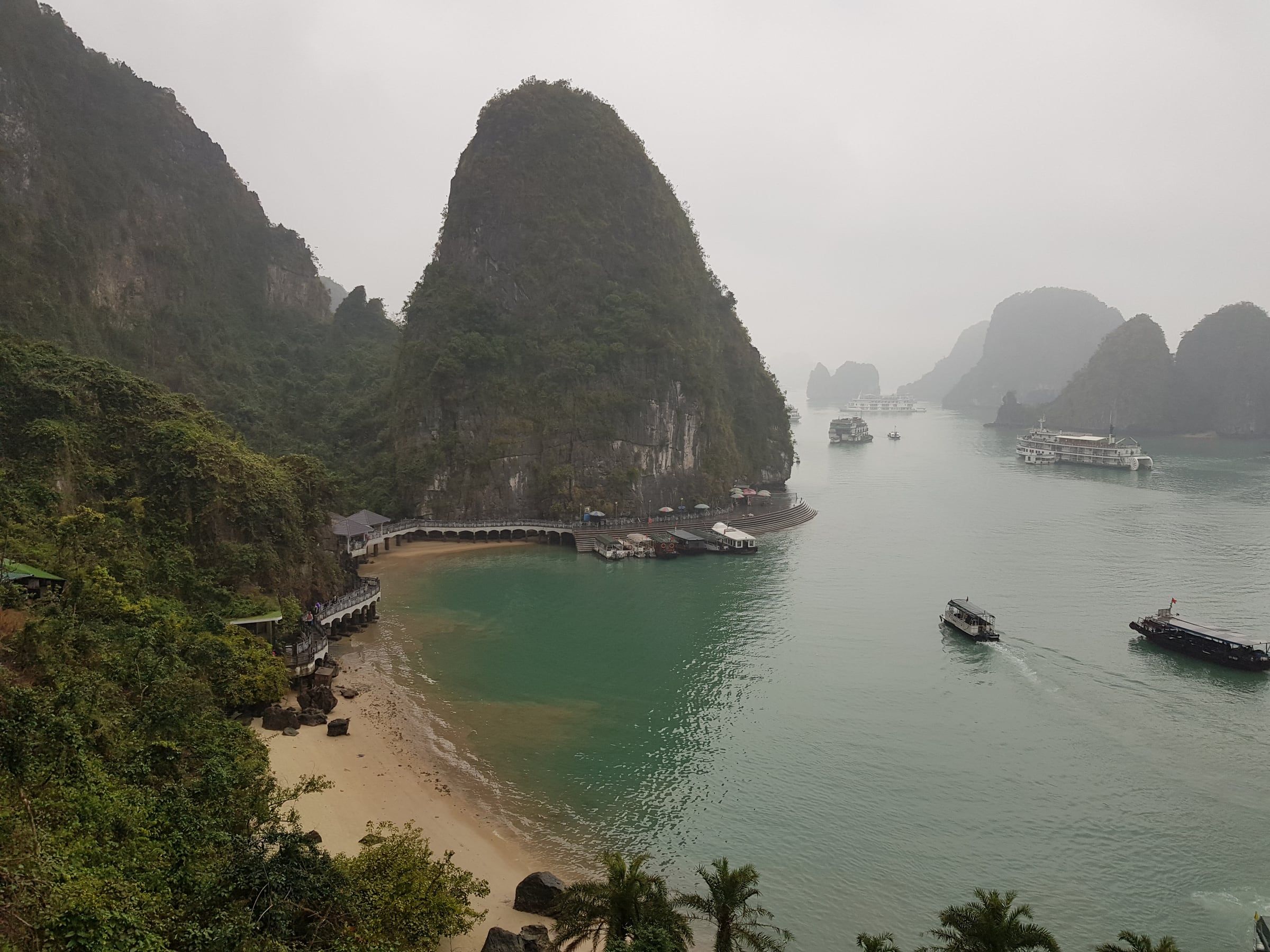
Hang Sửng Sốt A curved walkway and landing stage with sun umbrellas lie below a wooded limestone peak, with boats on pale green water in mist, seen from above at Sửng Sốt Cave. Photo: Andre Hospers, CC BY 4.0 -
Vịnh Hạ Long A cruise boat lies at anchor in the glare of a hazy low sun, with limestone islands behind, in Hạ Long Bay.

Vịnh Hạ Long A cruise boat lies at anchor in the glare of a hazy low sun, with limestone islands behind, in Hạ Long Bay. Photo: Vyacheslav Argenberg, CC BY 4.0 -
Vịnh Hạ Long Mist and still water mirror steep limestone cliffs at dawn in Hạ Long Bay.

Vịnh Hạ Long Mist and still water mirror steep limestone cliffs at dawn in Hạ Long Bay. Photo: Andrea Schaffer from Sydney, Australia, CC BY 2.0 -
Cái Bèo, đảo Cát Bà A blue and red fishing boat near Cái Bèo village on Cát Bà Island, with misty limestone hills behind, in January 2024.

Cái Bèo, đảo Cát Bà A blue and red fishing boat near Cái Bèo village on Cát Bà Island, with misty limestone hills behind, in January 2024. Photo: Jakub Hałun, CC BY 4.0
Typhoons and storm warnings
The storm season runs from June to November and is most active from July to September. When a storm approaches, sailings are suspended from a stated hour until the storm’s final bulletin, and the Board posts the notice.
Vietnam’s construction regulation puts the storm season at June to November nationwide. In Vietnamese practice a storm, bão, is a tropical cyclone with winds of force 8 or more; tropical depressions are weaker. Between 1961 and 2025, 114 storms of at least tropical-storm strength passed within 200 km of the bay, about 1.75 a year, and 31 of them reached typhoon strength within that distance, roughly one every two years. Eleven of those 65 years had none at all.
| Month | Storms, 1961 to 2025 | Share of years with one, 1991 to 2020 |
|---|---|---|
| May | 1 | a single storm on record |
| June | 11 | 17% |
| July | 29 | 50% |
| August | 34 | 43% |
| September | 23 | 30% |
| October | 13 | 20% |
| November | 3 | 7% |
How a suspension works
The port authority, or in some notices the provincial Department of Agriculture and Environment, stops clearing sightseeing and overnight boats to leave port from a stated hour. Overnight cruises are stopped first. Boats already out must bring guests back to the mainland by a stated time, and boats on their way back are still cleared in. The stop lasts until the final bulletin on the storm. The Board posts each notice on its website and the provincial press repeats it, so a guest can check whether a cancellation is official.
Recent notices show the pattern. On 13 June 2025 overnight boats stopped and day boats had to land their guests before 18:00. On 20 July 2025 every tourist boat on the bay stopped being cleared to leave. On 3 July 2026 overnight and evening trips stopped from noon, a day before the storm arrived.
Typhoon Yagi was the hardest test. It made landfall on 7 September 2024, tours stopped from 7 to 12 September, three of the five routes then running reopened on 13 September and all five by 20 September. Twenty-three tourist boats sank at Tuần Châu (Tuan Chau) International Port, and 95% of the greenery at the visitor sites was broken or uprooted.
Squalls that no storm notice covers
Sudden thunderstorm squalls are the gap. On 19 July 2025 a day boat capsized in a squall near Hang Đầu Gỗ (Dau Go Cave): 49 people were aboard, 39 died and 10 were rescued. Accounts of the warnings differ. Quảng Ninh officials said the bay forecasts at 06:30 and 10:00 gave winds of force 2 to 3 and the squall warning came at 13:30, after the boat had left a little before 13:00; the national forecasting centre said a 04:30 marine bulletin had mentioned possible tornadoes, with alerts at 11:45 and 13:30.
By July 2026 an online warning system for thunderstorms, squalls and lightning covered Ha Long and Bai Tu Long bays, giving about 30 minutes’ notice across nine zones to boat owners and tourism businesses. Its own report stresses that storms at sea come fast and cover small areas. Since August 2025 six sheltered spots along the sightseeing routes have been set aside for boats caught by a squall, and military medical vessels and patrol boats watch the bay around the clock.

What to pack for each season
Layers suit December to March, light clothes with a jumper suit April, May, October and November, and quick-drying clothes with swimwear suit June to September.
December to March
A fleece or light down jacket, long trousers, a windproof shell, a scarf or hat for the open deck at sunrise and sunset, closed shoes and a light rain jacket for the drizzle.
April, May, October and November
T-shirts with a light jumper for the evening, a rain jacket, a sun hat and sunscreen, and sandals or trainers with grip for wet cave steps.
June to September
Light, quick-drying clothes, swimwear, strong sunscreen, a hat and sunglasses, a compact umbrella or poncho, insect repellent and shoes that hold on slippery steps.
Questions visitors ask
What is the weather like in Ha Long Bay?
Summers, from May to September, are hot and wet, with highs of 30 to 32°C and 183 to 431 mm of rain a month. Winters are cooler and drier, with nights of 14 to 15°C from December to February, and February to April is grey, with drizzle and mist. About 1,900 mm of rain falls in a year, 71% of it from June to September.
Is it cold on a Ha Long Bay cruise?
On deck it can be, from December to February: daytime highs are 19 to 22°C, nights 14 to 15°C, and the winter monsoon wind is strongest in December and January. Layers help, because the wind makes sunrise and sunset feel colder than the temperature suggests. Whether cabins are heated was not checked.
How is the weather in Ha Long Bay now?
This guide shows no live forecast. The official check is the sailing notice from the port authority or provincial department, which the Board posts. Ask the operator about fog and strong-wind days, because no fog or wind threshold is published.
Is it safe to travel to Ha Long Bay now?
No guide can answer that for today. Sailings are suspended when a storm is forecast and the Board posts the notice, but sudden thunderstorm squalls can still form without one, so ask the operator about conditions on the day.
When is Ha Long Bay misty?
In February and March. The Bai Chay station records drizzle on 6.9 days in February and 9.8 in March, and fog or mist on 2.5 and 4.2 days. January and April have some mist, and May to December very little.
What is Ha Long Bay like in December?
Cool and the driest month of the year: highs of 21.7°C, nights of 15.3°C, 18.1 mm of rain on 5.2 days, 127.7 hours of sun and a sea of 22.1°C. The wind rises with the winter monsoon, so layers help on deck.
What is Ha Long Bay like in January?
The coolest month: highs of 19.3°C, nights of 14.0°C, 27.7 mm of rain on 7.6 days, drizzle on about three days and fog or mist on about one. The sea is about 19.7°C.
Can you swim in Ha Long Bay, and how warm is the sea?
The sea is warmest from June to September, at 29.1 to 29.8°C, and coolest in February, at 19.2°C. Swimming is allowed only at licensed beaches; in 2023 Ti Top Island had the only one operating.
Sources
Facts checked- Ministry of Construction, Vietnam, QCVN 02:2022/BXD, national technical regulation on natural and climatic data for construction (Circular 02/2022/TT-BXD), Tables A.1 to A.33, Bãi Cháy station, 26 September 2022.
- NOAA, Optimum Interpolation SST v2.1 daily data, averaged for the three open-water cells nearest the bay, 1991 to 2020, read October 2026.
- NOAA, IBTrACS v04r01, Western Pacific best tracks, storms within 200 km of Bãi Cháy, 1961 to 2025, file updated 2 October 2026.
- Ha Long Bay Management Board, Điều kiện tự nhiên (Natural conditions), updated 6 November 2024.
- Ha Long Bay Management Board, Tạm ngừng cấp phép đối với các phương tiện thủy hoạt động và lưu trú trên biển, 13 June 2025.
- VietnamPlus, Ứng phó với bão số 3: Quảng Ninh tạm dừng cấp phép rời cảng đối với tàu khách, 20 July 2025.
- Báo Quảng Ninh, Tạm ngừng cấp phép tàu từ 13 giờ ngày 18/8, 18 August 2025.
- Thanh Niên, Tàu du lịch tạm dừng hoạt động trên vịnh Hạ Long để tránh bão, 3 July 2026.
- Ha Long Bay - Yen Tu World Heritage Management Board, Tạm dừng cho phép rời cảng, bến các tàu thuyền hoạt động tham quan, lưu trú trên biển kể từ 07 giờ ngày 22/8/2026, 21 August 2026.
- Ha Long Bay Management Board, Ban Quản lý vịnh Hạ Long khắc phục thiệt hại bão số 3, 20 September 2024.
- Tuổi Trẻ, Cận cảnh loạt tàu đắm ở vịnh Hạ Long 2 tuần sau bão Yagi, 22 September 2024.
- Nhân Dân, Trung tâm Dự báo Khí tượng thủy văn quốc gia lý giải nguyên nhân mưa dông mạnh tại Quảng Ninh và Bắc Bộ, 19 July 2025.
- VietnamPlus, Siêu dông gây lật tàu ở vịnh Hạ Long: Vì sao dự báo trước vẫn rất khó lường?, 22 July 2025.
- VnExpress International, Search for victims of Ha Long Bay boat accident concludes with 39th body found, 27 July 2025.
- VnExpress, Giông sét trên vịnh Hạ Long được cảnh báo sớm trước 30 phút, 28 July 2026.
- Báo Quảng Ninh, Gia tăng biện pháp an toàn cho tàu du lịch, 12 August 2025.
- VnExpress, Du khách tham quan vịnh Hạ Long không được đứng trên mũi tàu, 18 May 2022.
- Thanh Niên, Vì sao cả vịnh Hạ Long chỉ có một bãi tắm được cấp phép?, 8 May 2023.
Prices, fees and timetables change. Figures on this page were checked in the month shown on the postmark.