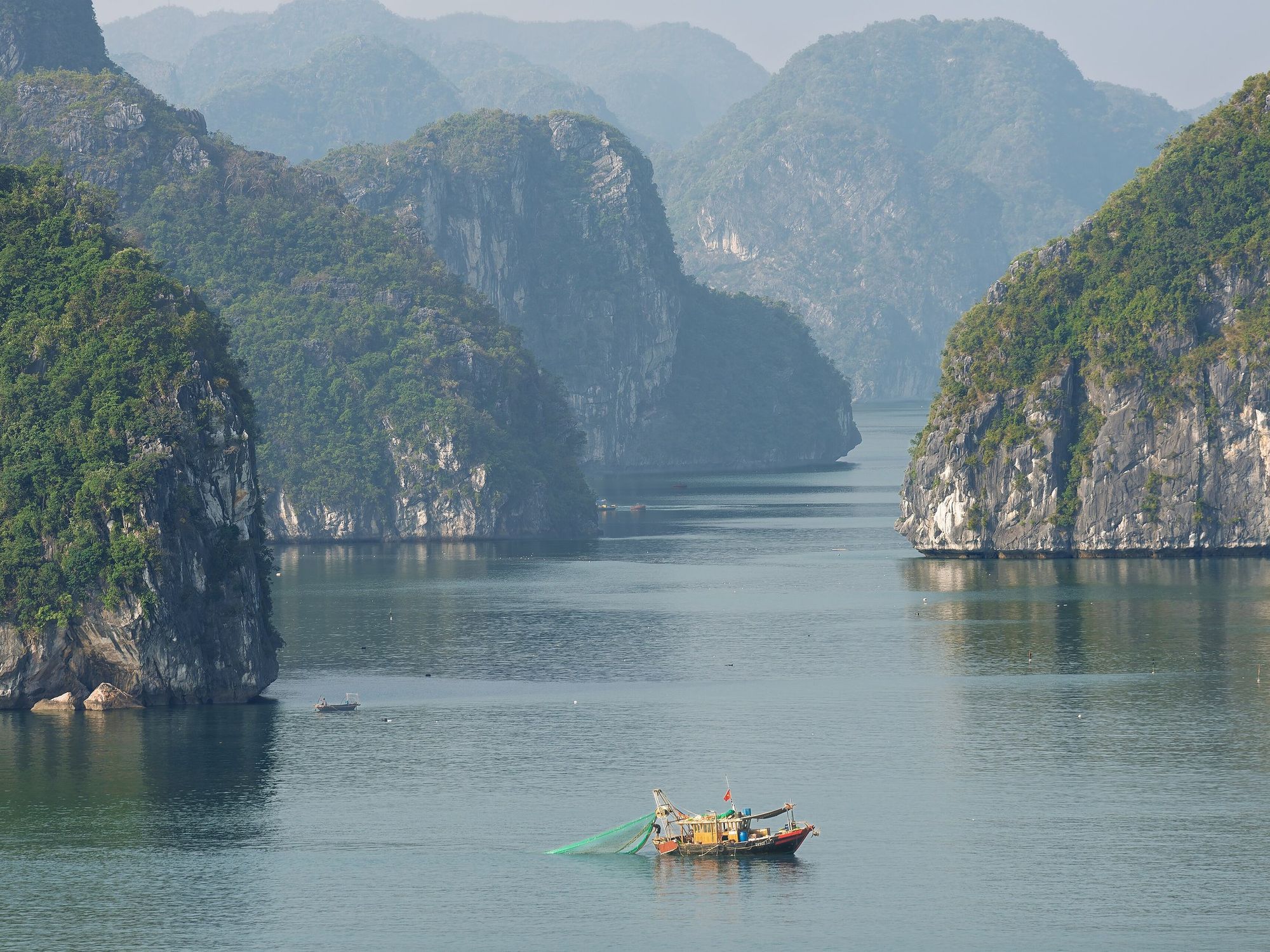
Vịnh Hạ Long (Ha Long Bay) has no single best month for everyone, but the station record is clear about the pattern. The year below starts in December and runs through the four blocks this guide uses.
Cool and fairly dry
- Dec 5.2 rain days Mist rare Storms none
- Jan 7.6 rain days Mist some Storms none
Grey and damp
- Feb 10.4 rain days Mist frequent Storms none
- Mar 14.3 rain days Mist frequent Storms none
- Apr 11.4 rain days Mist some Storms none
Hot and wet
- May 12.0 rain days Mist rare Storms low
- Jun 15.5 rain days Mist rare Storms low
- Jul 16.5 rain days Mist rare Storms high
- Aug 18.7 rain days Mist rare Storms high
- Sep 14.1 rain days Mist rare Storms moderate
Bright autumn
- Oct 9.2 rain days Mist rare Storms moderate
- Nov 5.8 rain days Mist rare Storms low
The best months, by what you want
No single month wins on every count. Late October to November gives the clearest views, June to September the warmest sea, with the most rain and storms, and weekdays outside public holidays the thinnest crowds.
| What you want | Months | Why | What to weigh |
|---|---|---|---|
| Clear views and photographs | Late October to November | Humidity 78.5% in October and 76.7% in November; fog and drizzle almost absent; rain days fall from 9.2 to 5.8; 156 to 177 hours of sun a month | A storm came within 200 km in 20% of Octobers, so early October carries some risk. No visibility record exists. |
| A warm sea for swimming | June to September | Sea 29.1 to 29.8°C; May (26.9°C) and October (27.8°C) are warm too | Wet and thundery: the storm season runs from June to November and is most active from July to September. Swimming only at licensed beaches. |
| Warm water with fewer rain days | Late May, late September and October | 12.0 rain days in May and 9.2 in October, against 16.5 in July and 18.7 in August | A compromise, and September and October still carry storm risk. |
| Mild walking weather | October to early December; late March to April | Days of 22 to 29°C and nights of 15 to 22°C, without the heat of May to September | March is the dullest month (42.9 hours of sun); April still has drizzle on 3.6 days. |
| Mist and soft light | February to April | Fog on 2.5, 4.2 and 1.4 days and drizzle on 6.9, 9.8 and 3.6 days | Mostly grey skies (43 to 89 hours of sun a month), so views are often hazy. |
| Fewer crowds | Weekdays outside public and school holidays | The Board publishes no month-by-month visitor series, so no quiet month is established | The Board calls October to April the international peak season. |
| Lower prices | No cheapest month is established | Official fees do not change with the season, and cruise rates vary by operator | January to March outside Tết and the wet mid-summer weeks are the likeliest times for discounts, an inference only. |
If clear views are the point, aim for late October or November. Rain days drop from 9.2 in October to 5.8 in November, fog and drizzle all but disappear, and the sun shines for 156 to 177 hours a month. December is dry as well, 18.1 mm on 5.2 days, but it has less sun (127.7 hours) and cooler days, with highs of 21.7°C. Humidity is among the lowest of the year in all three months: 78.5% in October, 76.7% in November and 76.3% in December, the lowest.
For swimming the sea is warmest from June to September, at 29.1 to 29.8°C, and May and October are warm too. That warmth comes with the wet half of the year: 71% of the rain falls from June to September, with thunder on six to eleven days a month and the highest storm risk. Swimming is allowed only at licensed beaches; in 2023 Ti Tốp (Ti Top) was the only one operating in the bay.
Crowds are harder to call. The Board counted 12,000 to 13,000 visits a day in December 2025, more than 10,000 of them from abroad, and it describes October to April as the international peak season, while Vietnamese families come mainly in summer and at holidays. In early 2026 overnight cruises ran at about 70 to 75% occupancy, with some days full. Weekdays away from the holidays listed below are the safest bet.
Prices follow no published calendar. The official sightseeing fees stay the same all year, and one dated example of a discount, a five-star overnight cruise at about 1,500,000 VND a person in February 2024, came in a “room clearance” week 20 to 25% below normal rates.
-
Vịnh Hạ Long Low sun lights steep limestone cliffs behind a cruise boat and a small boat in Hạ Long Bay.
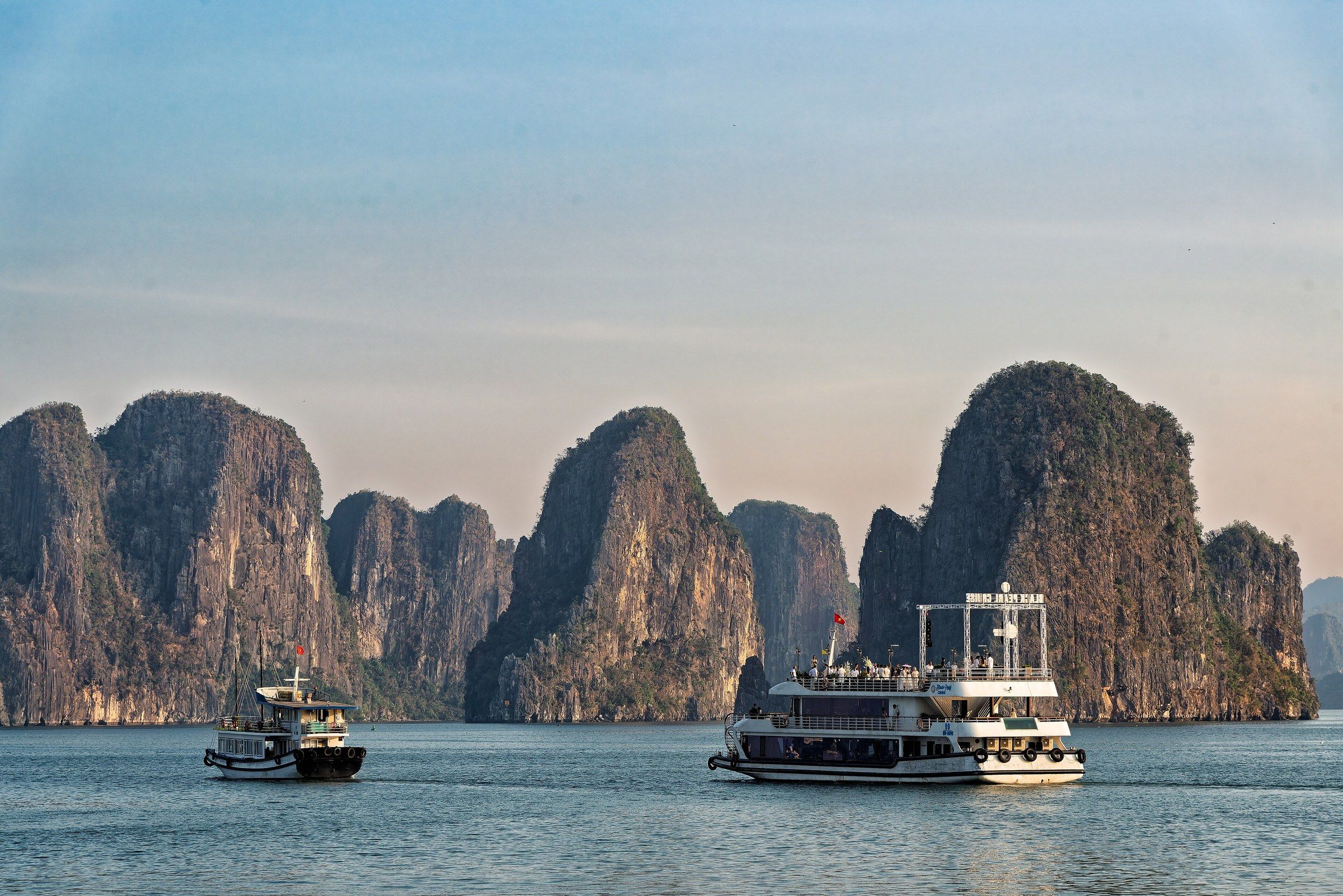
Vịnh Hạ Long Low sun lights steep limestone cliffs behind a cruise boat and a small boat in Hạ Long Bay. Photo: Mustang Joe, CC0 -
Vịnh Hạ Long A small boat lies at anchor in pink haze as the sun sets behind layered limestone ridges in Hạ Long Bay.

Vịnh Hạ Long A small boat lies at anchor in pink haze as the sun sets behind layered limestone ridges in Hạ Long Bay. Photo: Catatine, CC BY-SA 4.0 -
Vịnh Hạ Long A small boat crosses calm water under a violet and pink dusk sky in Hạ Long Bay.
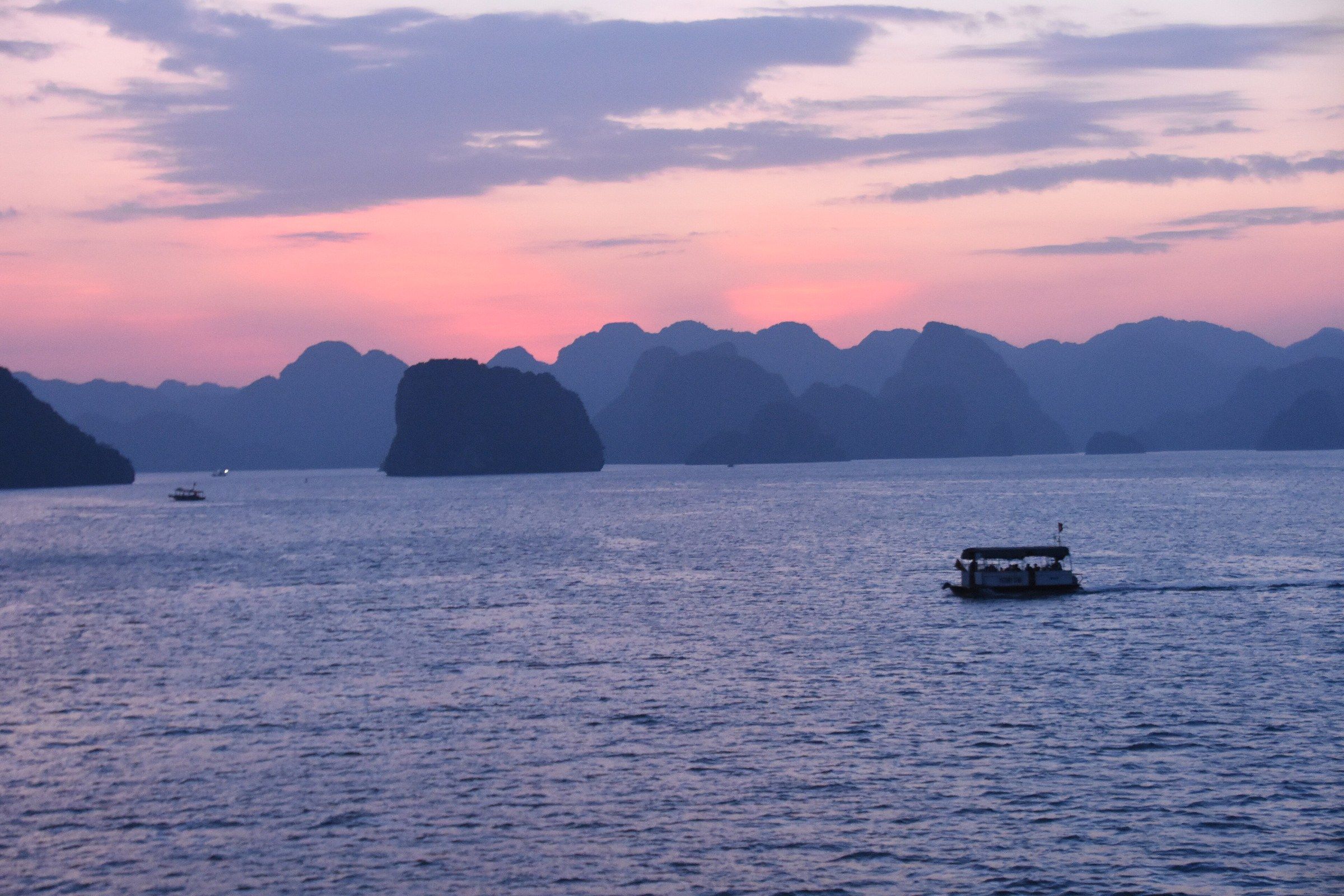
Vịnh Hạ Long A small boat crosses calm water under a violet and pink dusk sky in Hạ Long Bay. Photo: shankar s. from Dubai, united arab emirates, CC BY 2.0 -
Vịnh Hạ Long A cruise boat and its tender on teal water beside tree-covered limestone islands in Hạ Long Bay.
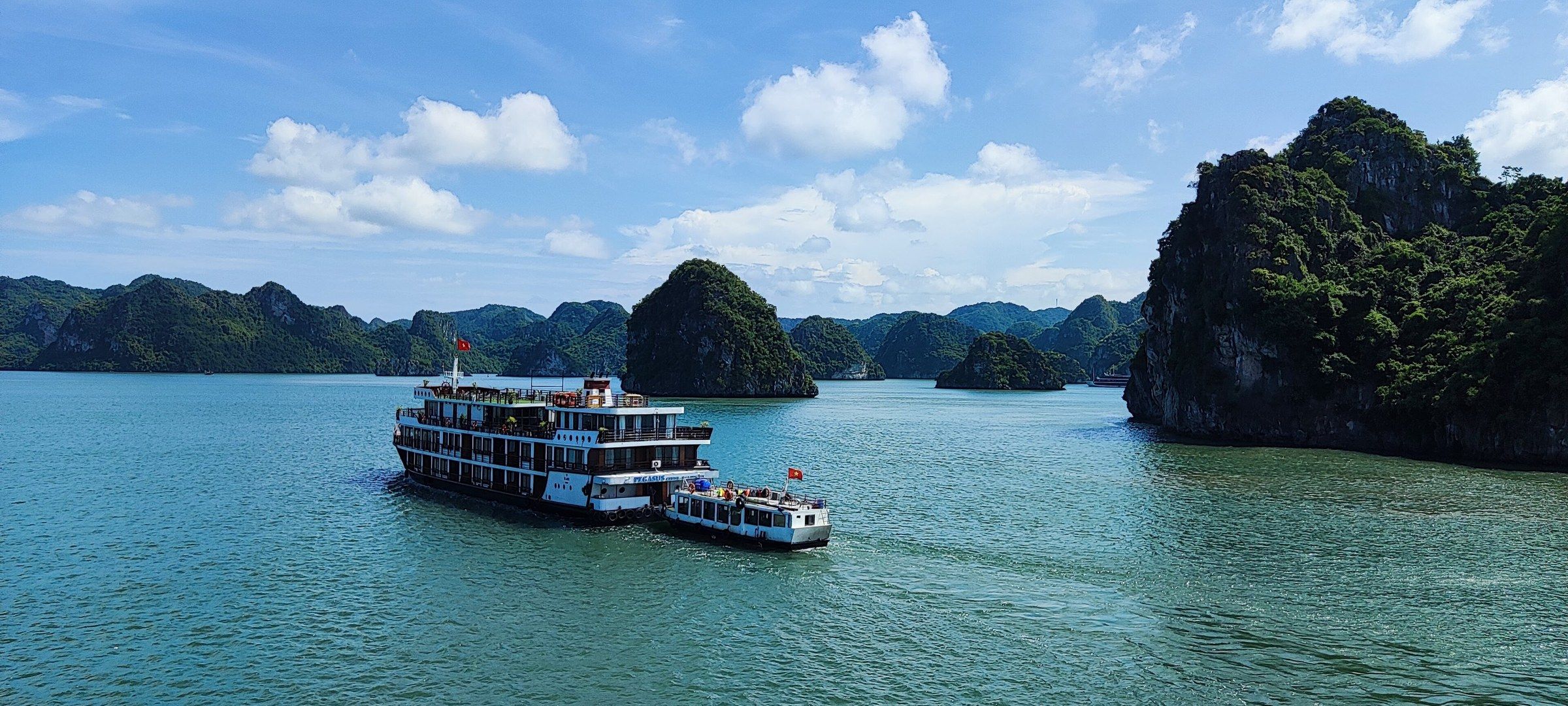
Vịnh Hạ Long A cruise boat and its tender on teal water beside tree-covered limestone islands in Hạ Long Bay. Photo: Shyamal, CC BY-SA 4.0 -
Vịnh Hạ Long A wooden junk lies still among limestone islets in pale morning mist in Hạ Long Bay.
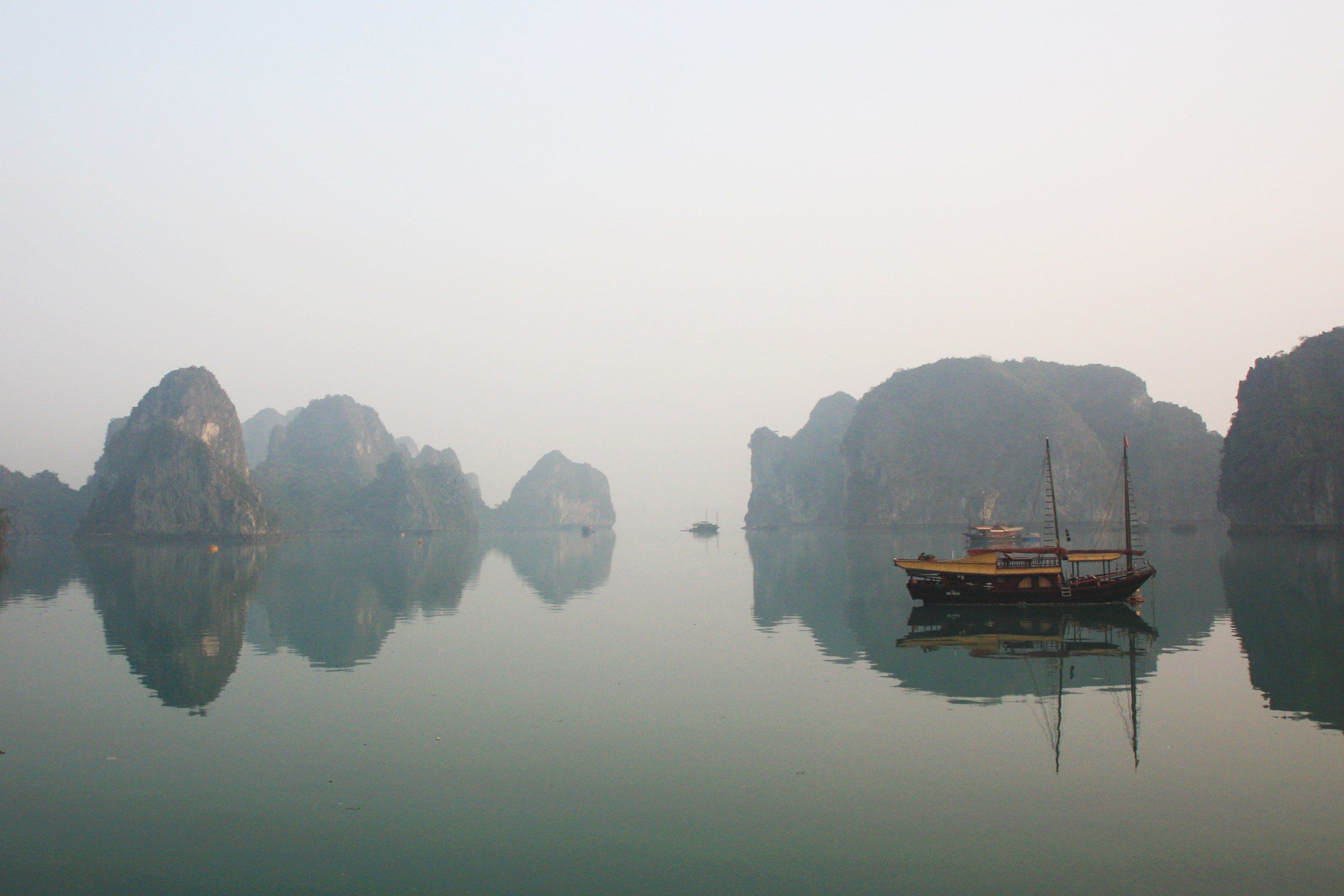
Vịnh Hạ Long A wooden junk lies still among limestone islets in pale morning mist in Hạ Long Bay. Photo: aschaf, CC BY 2.0 -
Vịnh Hạ Long Two kayaks cross calm grey water below tall limestone pillars in Hạ Long Bay.
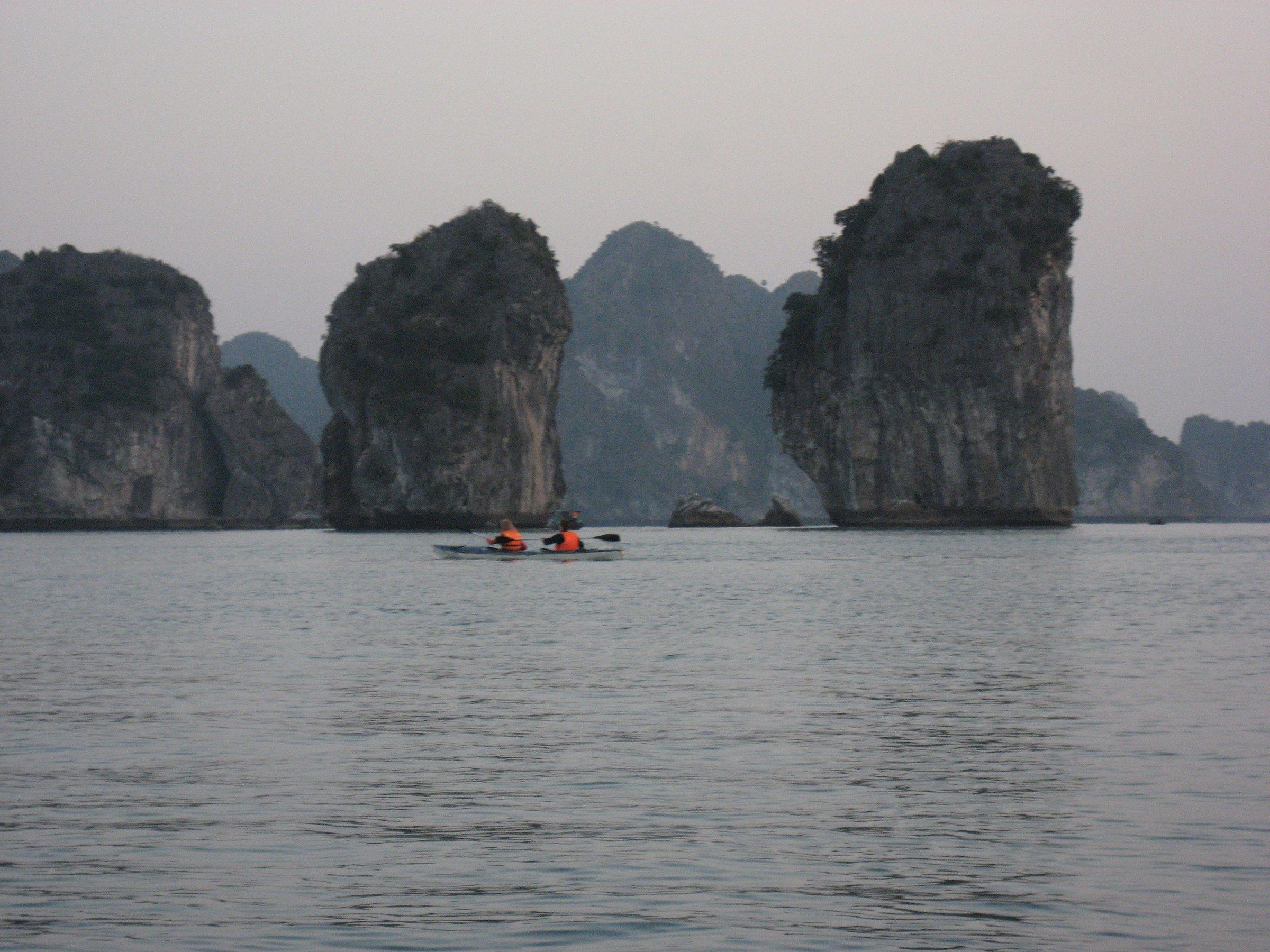
Vịnh Hạ Long Two kayaks cross calm grey water below tall limestone pillars in Hạ Long Bay. Photo: Arian Zwegers, CC BY 2.0
When to avoid Ha Long Bay
Avoid July to September if reliable sailings matter most, because storms come near the bay most often in those months. Avoid the Vietnamese holiday peaks (Tết, 30 April to 1 May and 2 September) and summer weekends if you want thinner crowds. February and March are the greyest months.
- July to September, for sailings. A storm passed within 200 km of the bay in 50% of Julys, 43% of Augusts and 30% of Septembers from 1991 to 2020, against 17% of Junes and 20% of Octobers. Summer is hot and wet too: highs of 30 to 32°C and 183 to 431 mm of rain a month.
- Tết, the Lunar New Year. During the nine-day break of 14 to 22 February 2026 the bay received 74,428 visitors, and the busiest day passed 13,000. The 2027 public holiday runs from Thursday 4 February to Wednesday 10 February, with the first day of the new year on Saturday 6 February. Expect a peak, and many services may close or charge holiday rates around the first three days.
- 30 April to 1 May. Nearly 15,000 visitors had entered the bay by 14:00 on 30 April 2026, hotels in Quảng Ninh were 90 to 95% full from 25 April to 2 May, and overnight cruises ran at 80 to 100% occupancy.
- 2 September, National Day. From 29 August to 2 September 2026 the Board counted 43,150 visitors.
- Summer weekends and school holidays. The Board and provincial press call June to August the summer peak, when Vietnamese families come; no figures are published.
- February and March, for views. They are the greyest months: 48.3 and 42.9 hours of sun, humidity of 84.0% and 87.1%, and drizzle on 6.9 and 9.8 days.
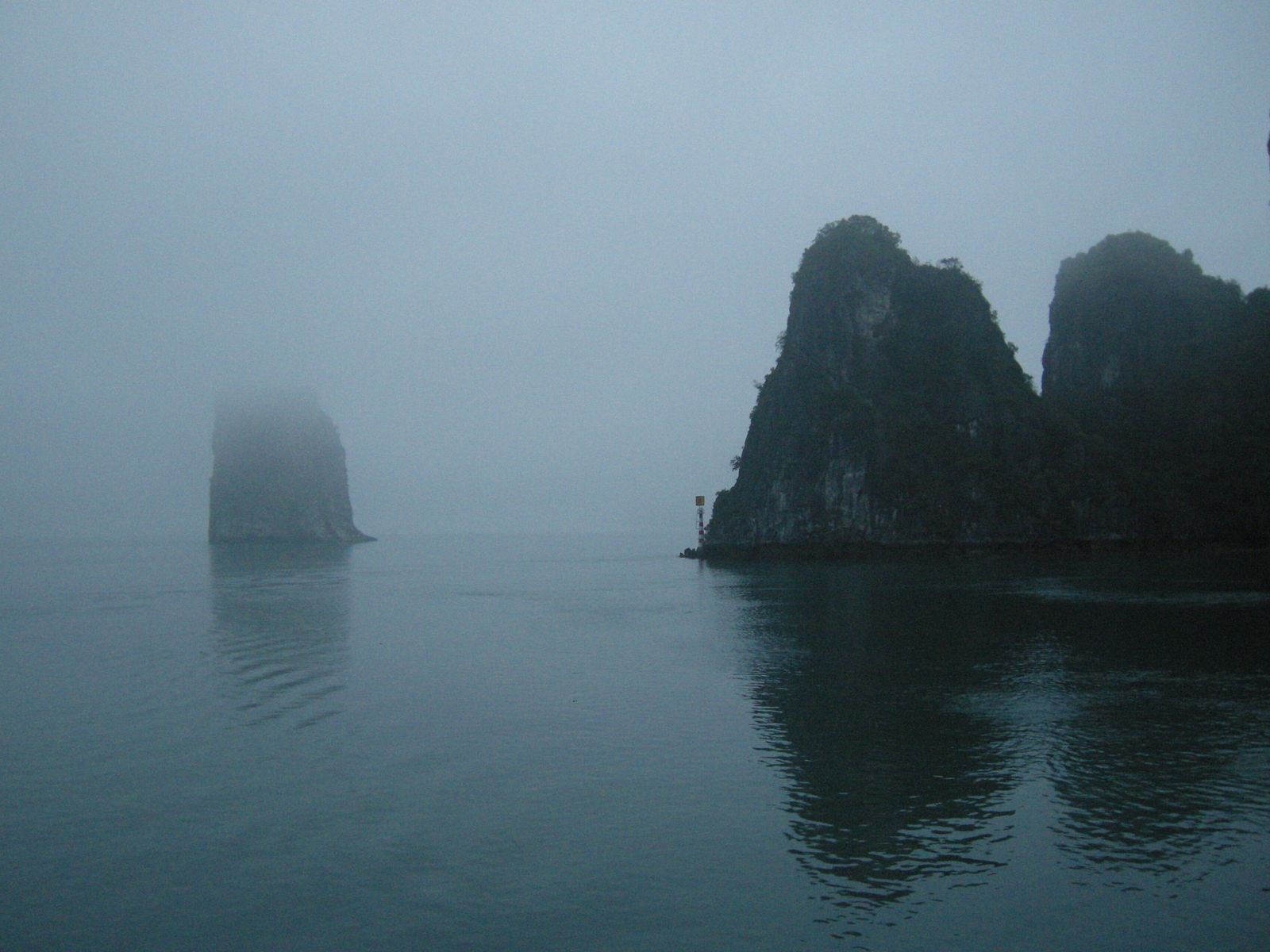
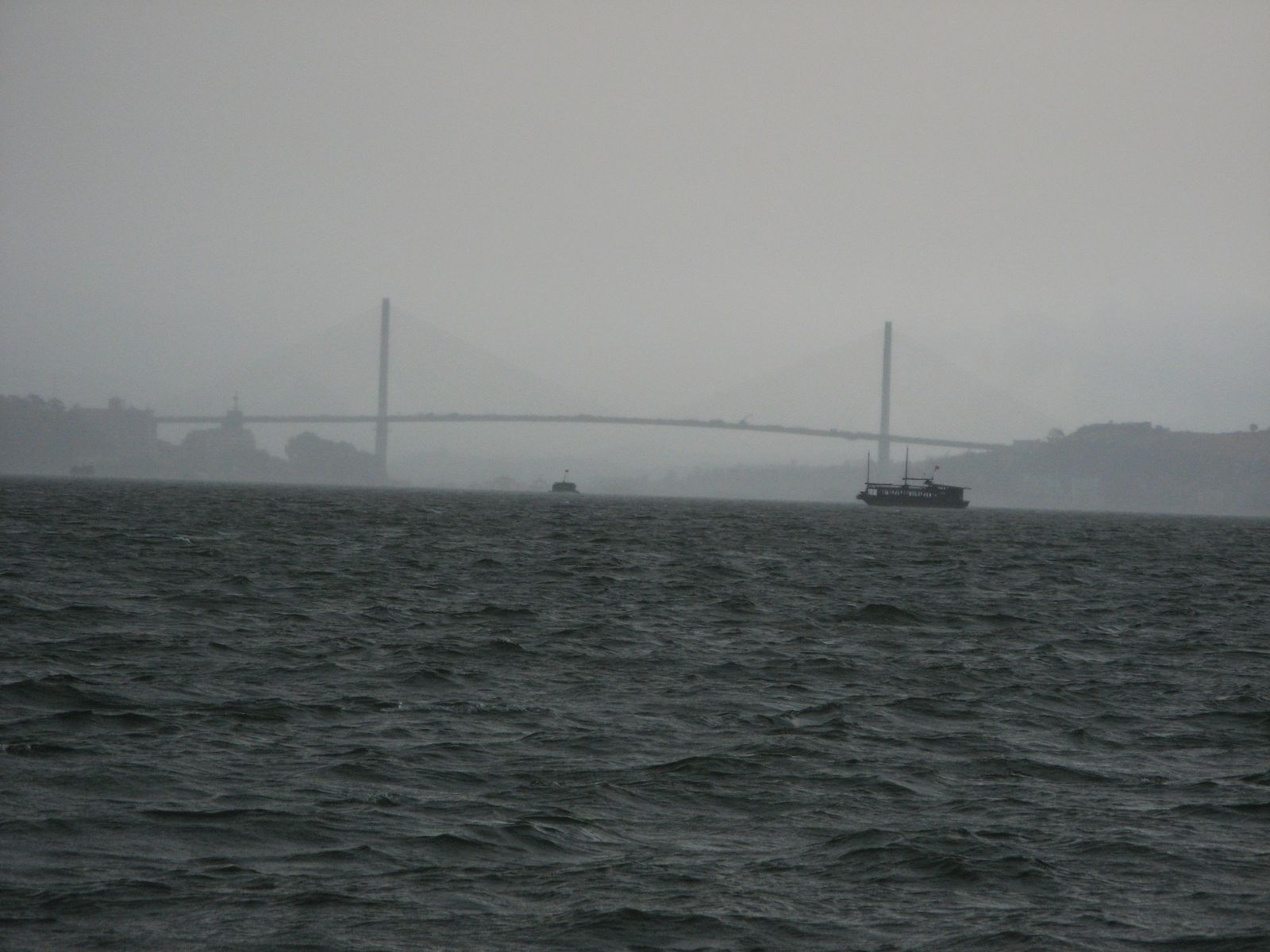
Typhoon season and cruise cancellations
The storm season runs from June to November and is most active from July to September. When a storm approaches, the port authority or a provincial department stops boats being cleared to leave port from a stated hour until the storm’s final bulletin, and the Board posts the notice.
Storms within 200 km of the bay, by month, 1961 to 2025
| Month | Storms, 1961 to 2025 | Share of years with one, 1991 to 2020 |
|---|---|---|
| May | 1 | a single storm on record |
| June | 11 | 17% |
| July | 29 | 50% |
| August | 34 | 43% |
| September | 23 | 30% |
| October | 13 | 20% |
| November | 3 | 7% |
Vietnam’s construction regulation puts the storm season at June to November nationwide and notes that from June to September most landfalls are on the coast from Quảng Ninh to Thanh Hóa. Near the bay, 114 storms passed within 200 km between 1961 and 2025, about 1.75 a year, and 31 reached typhoon strength within that distance, about one every two years. Eleven of the 65 years had none, so a typhoon does not hit every year, but in July and August the odds of one passing are close to even.
What happens to a cruise when a storm is forecast
Sailings stop only when an official notice withholds clearance to leave port; the bay never “closes” for a season. A notice works like this:
- The port authority, or in some notices the provincial Department of Agriculture and Environment, stops clearing sightseeing and overnight boats from a stated hour.
- Overnight cruises are stopped first, and boats already out must bring guests back to the mainland by a stated time.
- Boats on their way back are still cleared in.
- The stop lasts until the final bulletin on the storm, and the Board posts the notice on its website, where the provincial press repeats it.
That last step gives a guest an objective test: a “weather cancellation” is official when a notice exists.
| Date | Storm | What stopped |
|---|---|---|
| 13 June 2025 | Storm no. 1 (Wutip) | Overnight vessels stopped; day boats had to bring guests back to the mainland before 18:00. |
| 20 July 2025 | Storm no. 3 (Wipha) | All tourist vessels on Hạ Long Bay stopped being cleared to leave port; boats returning guests to the mainland were still cleared. |
| 18 August 2025 | Tropical depression | Clearance stopped from 13:00; boats at sea had to reach shelter by 15:00. |
| 3 July 2026 | Storm no. 1 (Maysak) | Overnight stays and evening sightseeing stopped from 12:00 and other vessels from 17:00, a day ahead of the storm. |
| 22 August 2026 | Not named in the notice | Sightseeing and overnight departures stopped from 07:00 until the final bulletin on the depression or storm. |
Typhoon Yagi, the strongest storm to hit Vietnam in three decades according to VnExpress, made landfall on 7 September 2024. Overnight cruises on Ha Long and Lan Hạ (Lan Ha) bays were cancelled from 5 September, tours stopped from 7 to 12 September, and all five routes then running had reopened by 20 September. Twenty-three tourist boats sank at Tuần Châu (Tuan Chau) International Port.
Storm notices do not cover sudden thunderstorm squalls. On 19 July 2025 a day boat capsized in one near Hang Đầu Gỗ (Dau Go Cave), and 39 of the 49 people aboard died. Since July 2026 an online warning system for thunderstorms, squalls and lightning has given boat owners about 30 minutes’ notice across nine zones of Ha Long and Bai Tu Long bays. The cruises page covers boat safety in full.
Seasons at a glance
The Board describes two seasons, winter from November to March and summer from May to September, with April and October as the turns between them. This guide splits the year into four blocks from the station figures.
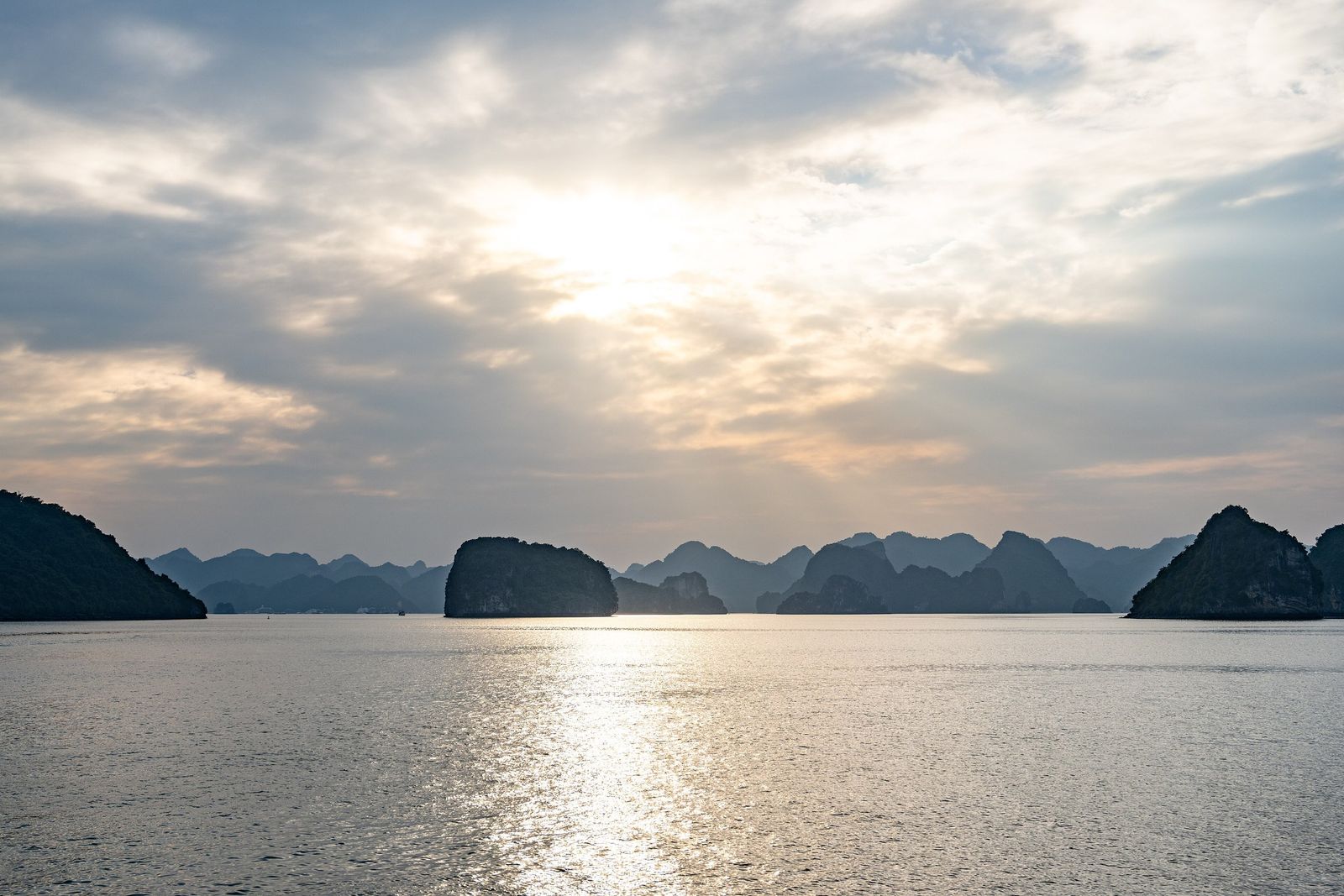
Cool and fairly dry: December and January
Days of 19.3 to 21.7°C and nights of 14.0 to 15.3°C, with 18.1 to 27.7 mm of rain on 5 to 8 days a month. The winter monsoon wind is at its strongest, so the open deck feels colder than the figures.
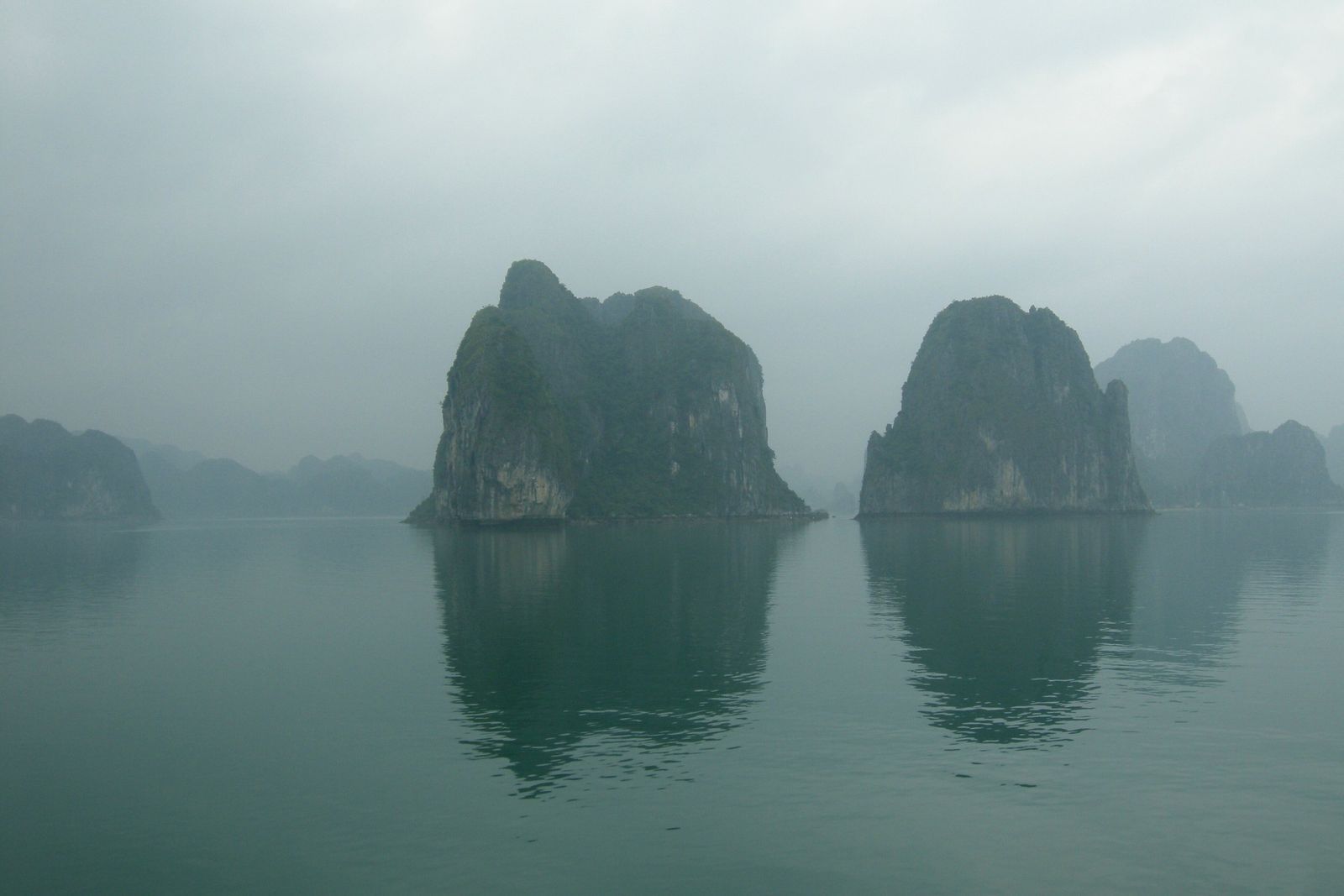
Grey and damp: February to April
Only 43 to 89 hours of sun a month, humidity of 84 to 87%, drizzle on 7 to 10 days in February and March, and fog or mist on up to four days in March.
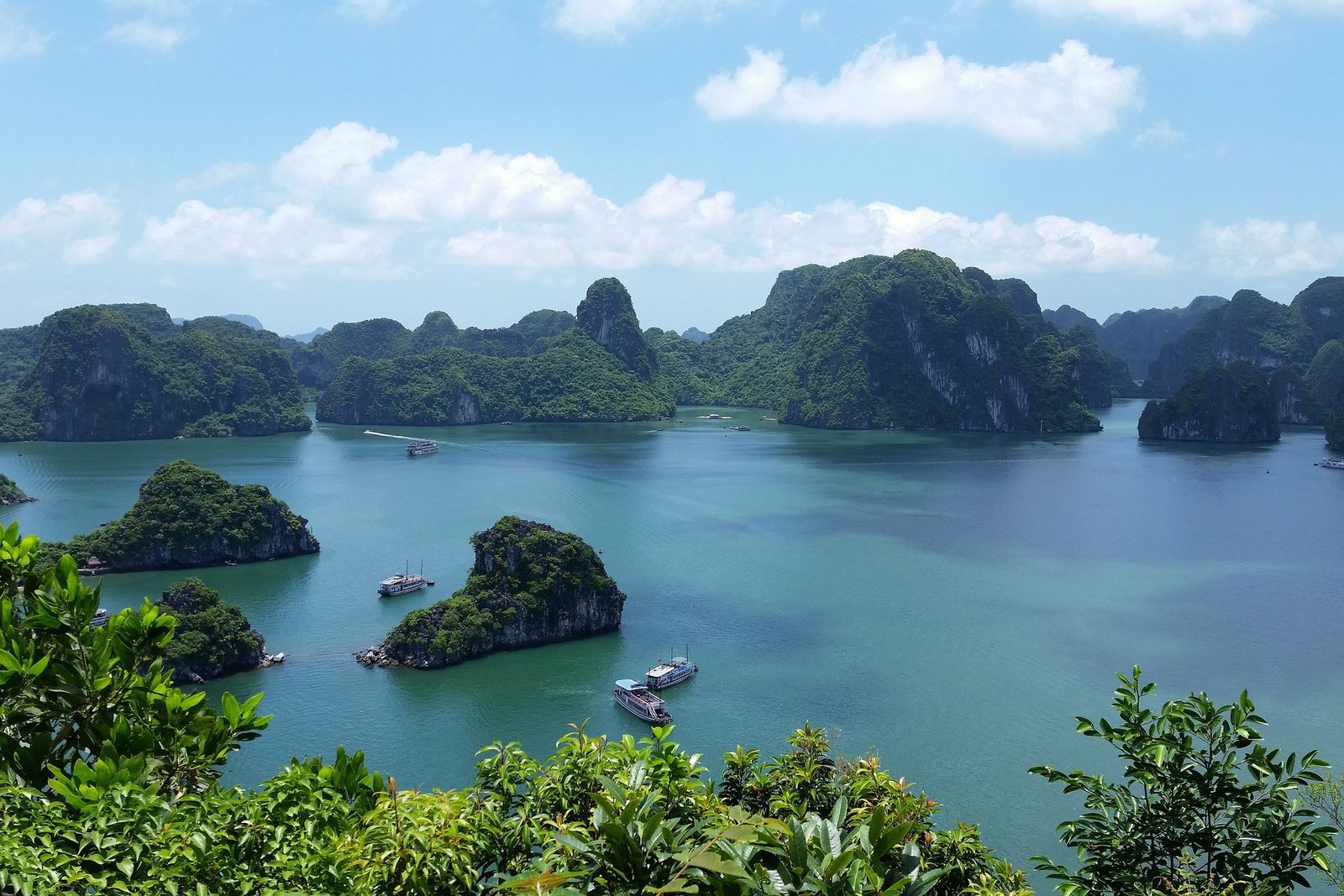
Hot and wet: May to September
Days of 30 to 32°C, nights of 24 to 26°C, 183 to 431 mm of rain a month on 12 to 19 days and thunder on 6 to 11. The sea is at its warmest, and the months fall in the storm season, which runs from June to November and is most active from July to September.
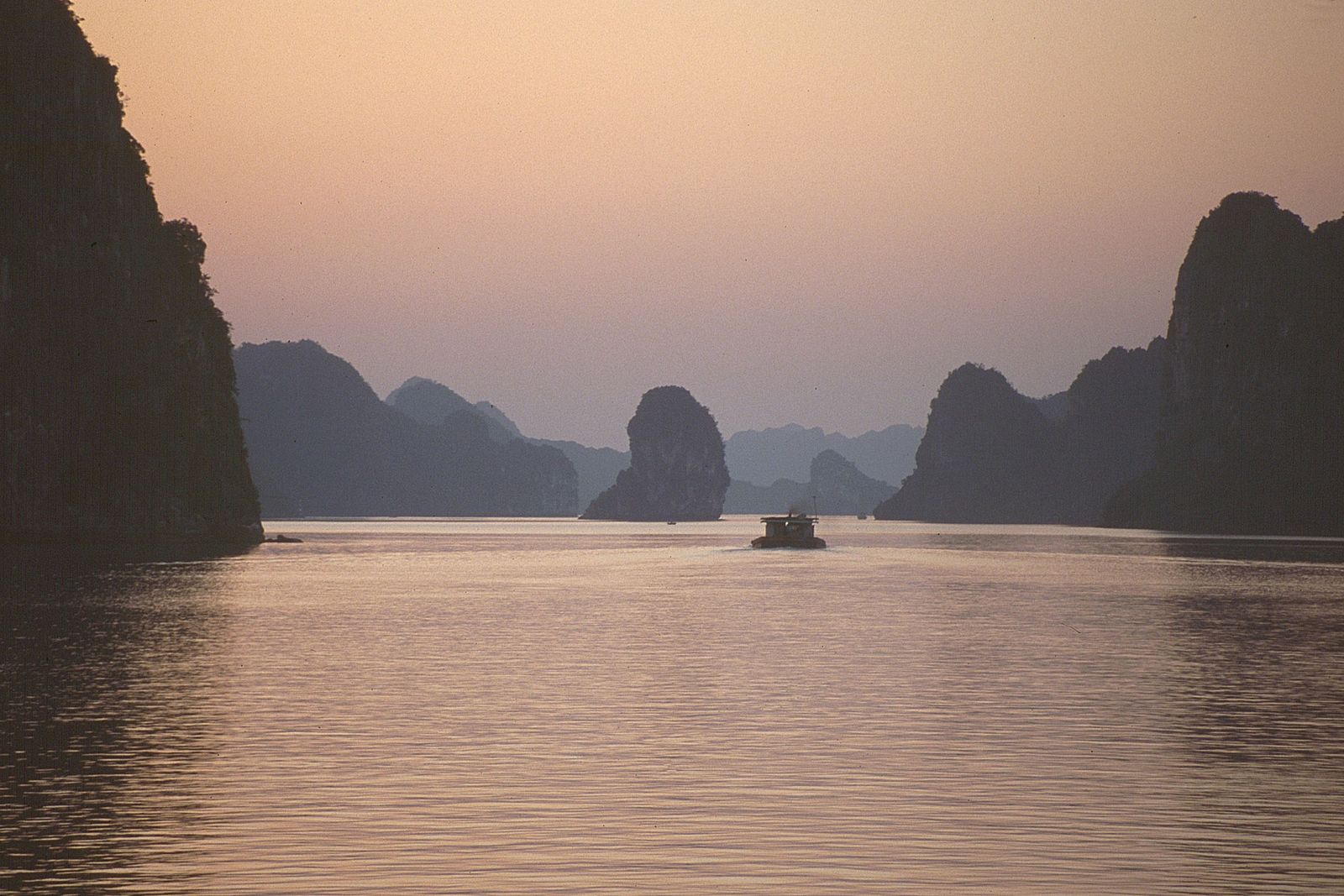
Bright autumn: October and November
Days fall from 28.8 to 25.5°C, rain days from 9.2 to 5.8, humidity sits at 77 to 79% and the sun shines 156 to 177 hours a month. October still has 142.6 mm of rain; November is far drier at 38.9 mm.
The record extremes frame these blocks. July is the hottest month, with a mean of 28.6°C, and January the coolest, at 16.2°C. Mean nights drop below 15.5°C from December to February, the lowest temperature on record is 1.7°C, in December, and 36°C or more has been reached in every month from May to September. Every month’s figures are on the weather page.
Holidays and festivals
Tết, the 30 April to 1 May holiday, 2 September and the summer school holidays bring the biggest Vietnamese crowds, while international visitors peak from October to April.
| When | What | What to expect |
|---|---|---|
| 4 to 10 February 2027 | Tết (Lunar New Year) public holiday; first day Saturday 6 February | A peak; many services may close or charge holiday rates around the first three days |
| The first three lunar months | Yên Tử spring festival | Opened on 26 February in 2026 |
| 30 April and 1 May | The 30 April to 1 May holiday, with Carnaval Hạ Long, an annual street parade and light festival (the 2026 edition opened on the evening of 30 April) | Hotels 90 to 95% full and cruises 80 to 100% booked in 2026; no 2027 Carnaval date announced |
| June to August | Vietnamese school holidays, the summer peak | Families at weekends; also the rainy, stormy season |
| 10th to 20th of the 6th lunar month | Quan Lạn communal-house festival, main day on the 18th | On Quan Lan island in Bai Tu Long Bay |
| Around 2 September | National Day break (29 August to 2 September in 2026) | 43,150 visitors to the bay over the five days in 2026 |
| 20 to 22 November 2026 | Hạ Long Heritage International Marathon, main race Sunday 22 November | About 18,000 runners; hotel rates rise sharply |
How long to stay
The plan-your-visit page covers how many days to give the bay. For weather, allow a spare day from July to September, because sailings stop when a storm approaches. A day trip from Hà Nội (Hanoi) is possible but rushed: about 11 to 12 hours door to door for about four hours on the water on the four-hour VHL1 route. Plan how many days.
Questions visitors ask
What is the best month to visit Ha Long Bay?
For clear views, late October to November: rain days fall from 9 in October to 6 in November, fog and drizzle are almost absent and storms become uncommon. December is also dry but has fewer hours of sun, and the sea is warmest from June to September.
Which month should you avoid?
July to September is the most storm-prone stretch, with a storm passing within 200 km of the bay in 50% of Julys, 43% of Augusts and 30% of Septembers. February and March are the greyest months, with drizzle on 7 to 10 days a month. Vietnamese holidays (Tết, 30 April to 1 May and 2 September) bring the biggest crowds.
Is there a typhoon season in Ha Long Bay?
Yes. The storm season runs from June to November and is most active from July to September, the months when most storms near the bay come. Between 1961 and 2025 no storm passed within 200 km of the bay from December to April.
What happens to a cruise when a storm is forecast?
The port authority or a provincial department stops boats being cleared to leave port from a stated hour until the storm’s final bulletin. Overnight cruises are stopped first, boats at sea go to shelter and boats returning with guests are still cleared in. The Board posts the notice.
Do you get a refund if a storm cancels the cruise?
No Vietnamese rule on refunds for weather cancellations was found, so the result depends on the operator’s contract. After the official storm bans of September 2024 operators returned deposits, and in July 2025 one group lost a deposit because its contract said so. Ask for the cancellation terms in writing.
When is Ha Long Bay cheapest?
No month-by-month price series is published. Official sightseeing fees do not change with the season, and private cruise rates vary by operator. January to March, outside Tết, and the wet mid-summer weeks are the likeliest times for discounts, but that is an inference.
When is Ha Long Bay least crowded?
No single quiet month is established, because the Board publishes no month-by-month visitor series. Weekdays outside public and school holidays are quieter than weekends and holiday periods.
How many days do you need in Ha Long Bay?
The plan your visit page covers this. For weather, allow a spare day from July to September, because sailings stop when a storm approaches. A day trip from Hanoi is possible but rushed, at about 11 to 12 hours for about four hours on the water.
Sources
Facts checked- Ministry of Construction, Vietnam, QCVN 02:2022/BXD, national technical regulation on natural and climatic data for construction (Circular 02/2022/TT-BXD), Bãi Cháy station tables and clause 3.1, 26 September 2022.
- NOAA, IBTrACS v04r01, Western Pacific best tracks, storms within 200 km of Bãi Cháy, 1961 to 2025, file updated 2 October 2026.
- NOAA, Optimum Interpolation SST v2.1 daily data, 1991 to 2020, read October 2026.
- Ha Long Bay Management Board, Điều kiện tự nhiên (Natural conditions), updated 6 November 2024.
- Ha Long Bay - Yen Tu World Heritage Management Board, Vịnh Hạ Long đón trên 10.000 khách quốc tế một ngày, updated 30 December 2025.
- Ha Long Bay - Yen Tu World Heritage Management Board, Hơn 91% khách đến vịnh Hạ Long là người nước ngoài, updated 17 April 2026.
- Ha Long Bay - Yen Tu World Heritage Management Board, 9 ngày nghỉ Tết, vịnh Hạ Long đón 74,428 lượt khách tham quan, 22 February 2026.
- Dân trí, Chính thức chốt nghỉ Tết Nguyên đán 2027, 2 October 2026.
- Ha Long Bay - Yen Tu World Heritage Management Board, Nô nức không khí kỳ nghỉ lễ 30/4-01/5 trên vịnh Hạ Long, 30 April 2026.
- Báo Quảng Ninh, Hiệu ứng tích cực từ các sự kiện kích cầu du lịch, 13 May 2026.
- Tuổi Trẻ, Du thuyền Hạ Long đắt khách dịp lễ 30-4, 23 April 2026.
- Ha Long Bay - Yen Tu World Heritage Management Board, Trên 43 nghìn lượt khách tham quan vịnh Hạ Long trong kỳ nghỉ lễ Quốc khánh 02/9, 2 September 2026.
- VietnamPlus, Du lịch Quảng Ninh khởi sắc, rộng đường về đích năm 2026, 1 October 2026.
- Ha Long Bay - Yen Tu World Heritage Management Board, Quảng Ninh sôi động cao điểm du lịch hè, 30 May 2026.
- Công Thương, Giải Marathon Quốc tế Di sản Hạ Long 2026 sẽ diễn ra tháng 11/2026.
- Báo Quảng Ninh, Hướng dẫn tham gia Carnaval Hạ Long 2026, 30 April 2026.
- VnExpress, Du thuyền Hạ Long 'xả phòng' đón khách, 12 February 2024.
- Ha Long Bay Management Board, Tạm ngừng cấp phép đối với các phương tiện thủy hoạt động và lưu trú trên biển, 13 June 2025.
- VietnamPlus, Ứng phó với bão số 3: Quảng Ninh tạm dừng cấp phép rời cảng đối với tàu khách, 20 July 2025.
- Báo Quảng Ninh, Tạm ngừng cấp phép tàu từ 13 giờ ngày 18/8, 18 August 2025.
- Thanh Niên, Tàu du lịch tạm dừng hoạt động trên vịnh Hạ Long để tránh bão, 3 July 2026.
- Ha Long Bay - Yen Tu World Heritage Management Board, Tạm dừng cho phép rời cảng, bến các tàu thuyền hoạt động tham quan, lưu trú trên biển kể từ 07 giờ ngày 22/8/2026, 21 August 2026.
- VnExpress, Hủy nhiều tour du thuyền đêm trên vịnh Hạ Long, Lan Hạ vì bão, 5 September 2024.
- Ha Long Bay Management Board, Ban Quản lý vịnh Hạ Long khắc phục thiệt hại bão số 3, 20 September 2024.
- VnExpress, Vịnh Hạ Long: Vụ lật tàu khiến du khách hủy chuyến, 24 July 2025.
- VnExpress, Giông sét trên vịnh Hạ Long được cảnh báo sớm trước 30 phút, 28 July 2026.
- Thanh Niên, Vì sao cả vịnh Hạ Long chỉ có một bãi tắm được cấp phép?, 8 May 2023.
Prices, fees and timetables change. Figures on this page were checked in the month shown on the postmark.