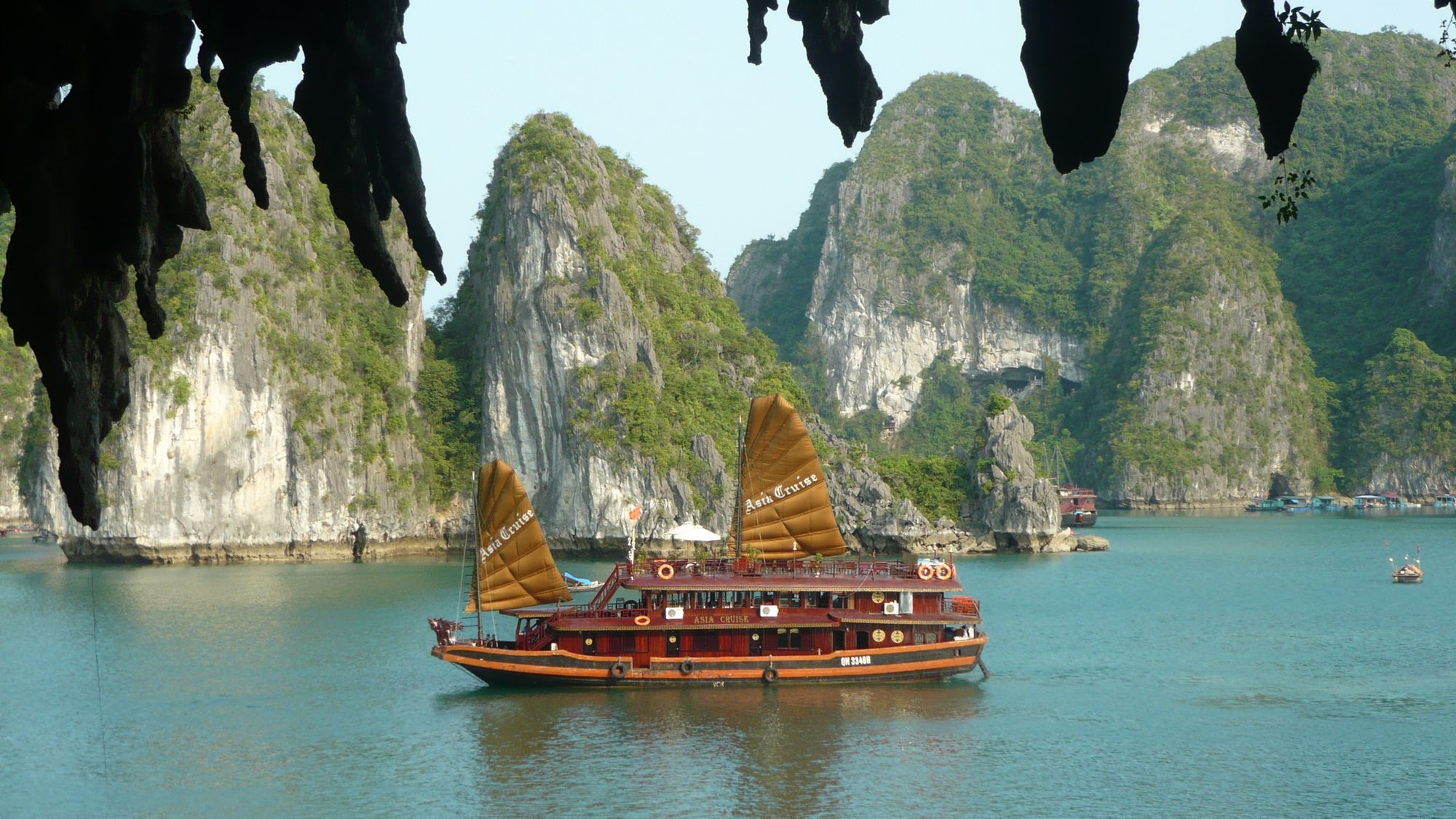
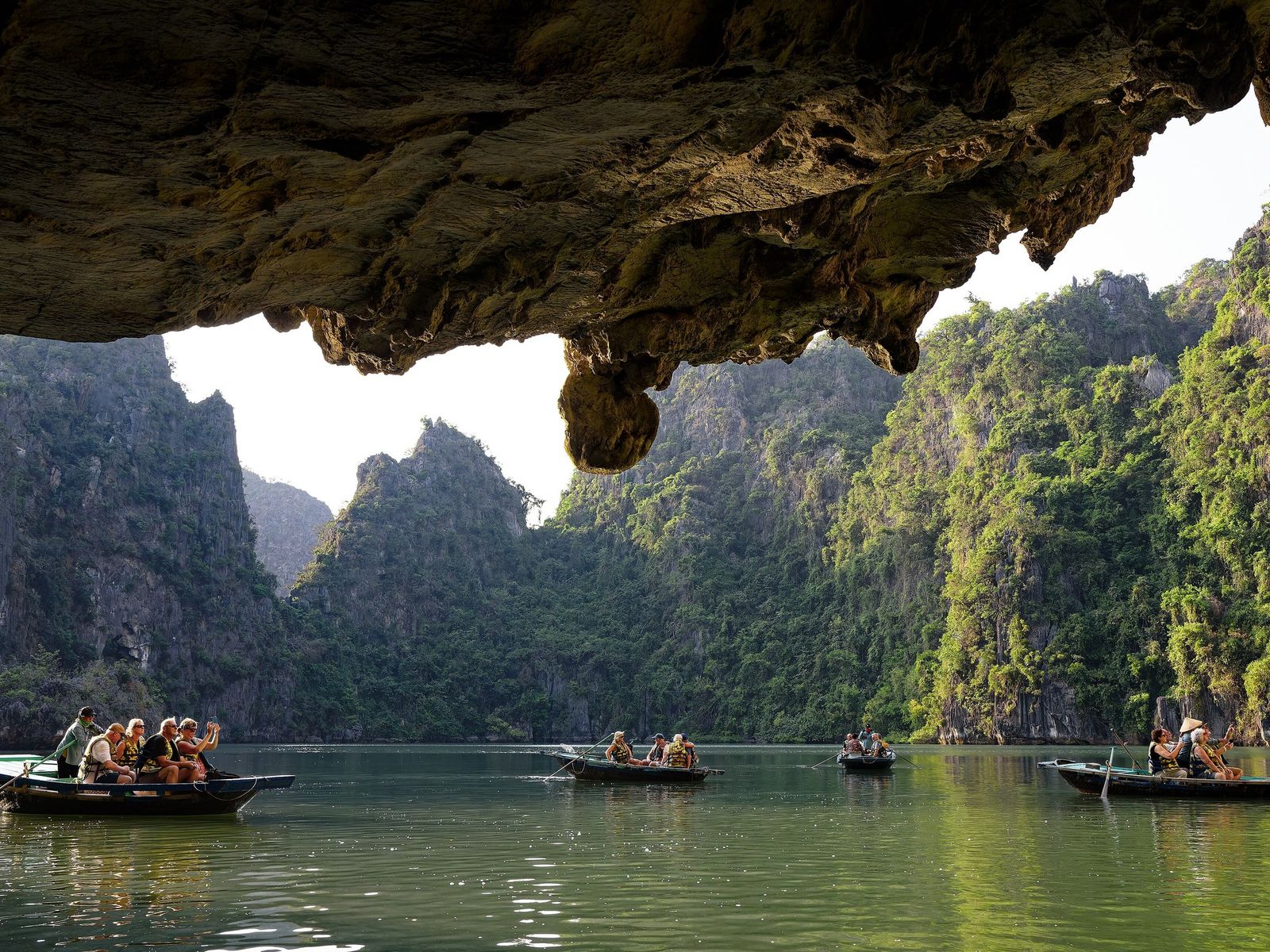
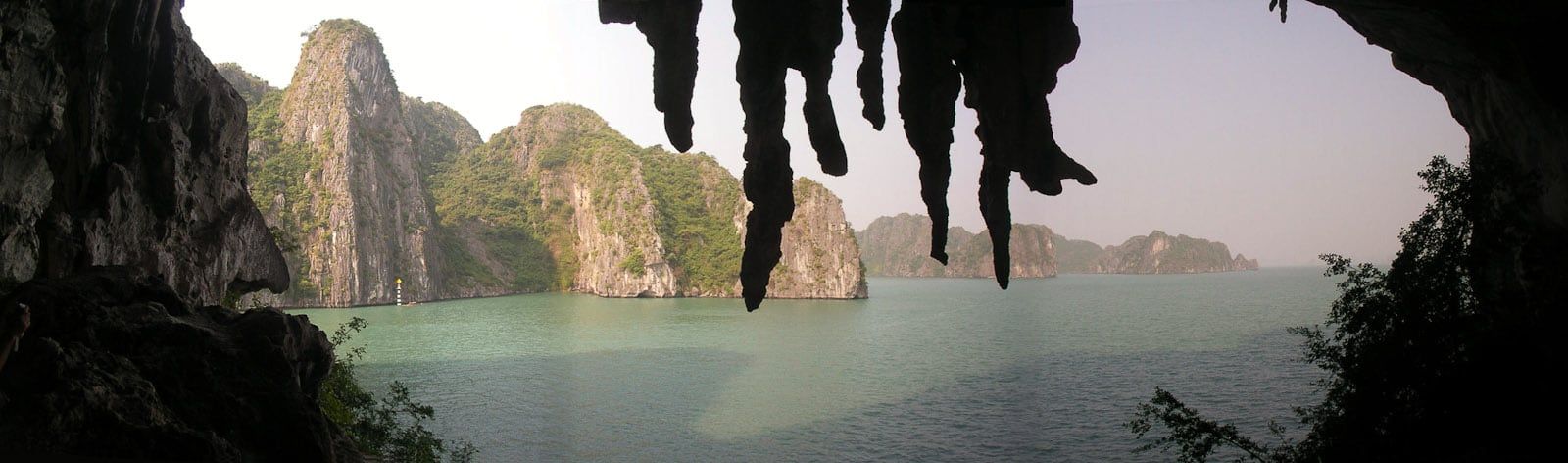
Vịnh Hạ LongA wooden junk with orange sails on turquoise water, seen between stalactites at a cave mouth in Hạ Long Bay.Photo: Arianos, Public domain
Which cave should you visit?
For the largest chamber choose Hang Sửng Sốt (Sung Sot Cave) on route 2. For white formations and a beam of afternoon light choose Động Thiên Cung (Thien Cung Cave) on route 1, and for a boat ride through a sea tunnel choose Hang Luồn (Luon Cave), also on route 2.
About 70caves in the core zone
12caves in tourism use
1.857 millionvisits to Sửng Sốt in 2024
The bay’s management board, the Ha Long Bay - Yen Tu World Heritage Management Board, counts about 70 caves in the core zone, 12 of them in tourism use, and it publishes the place pages, hours and price lists this page draws on.
The bay is visited on numbered official routes, VHL1 to VHL8, and one route ticket covers every stop on the route. There is no separate ticket for each cave, so the caves you see depend on the route your boat follows. The adult sightseeing fee is 250,000 VND on routes 1, 2 and 5 and 200,000 VND on routes 3 and 4 (checked October 2026). Check opening hours and fees before you choose a boat.
The caves on the official routes, with sizes and step counts from the Board's place pages and the press, and 2024 visit counts from Báo Quảng Ninh (30 December 2025). Checked October 2026.
Cave
Route
Size
Steps
Crowds
Best for
Động Thiên Cung (Thien Cung Cave)
VHL1, VHL5
About 3,000 m² floor, 3 chambers, central vault about 30 m high
Not published (narrow cliff path with separate up and down lanes)
Over 710,000 visits in 2024; overloaded at summer peaks and holidays
White formations and the Heaven's Gate light beam, about 14:00 to 16:30 on sunny days
Hang Đầu Gỗ (Dau Go Cave)
VHL1, VHL5
About 5,000 m², 3 chambers
90 steps from the shore to the entrance
Not published
History (the Bạch Đằng stakes tradition and the Khải Định stele of 2 May 1918) and daylight in the first chamber
Hang Sửng Sốt (Sung Sot Cave)
VHL2
About 10,000 m², over 200 m long, the largest cave open to visitors
About 50 steep steps up from the pier, then more than 10 down
The busiest cave, with about 1.857 million visits in 2024
The scale of the last chamber, with its scalloped dome and daylight from the roof
Hang Luồn (Luon Cave)
VHL2
Sea tunnel into a lagoon; tunnel size not published
Not published (entered by bamboo rowing boat or kayak)
Overloaded at summer peaks and holidays; no recent visit count published
A boat ride through the tunnel into a cliff-ringed lagoon, with macaques around it
Động Mê Cung (Me Cung Cave)
VHL2
4 main chambers joined by slits one person wide; corridors nearly 100 m long
Not published (entrance about 25 m up)
Not published
Archaeology of the Soi Nhụ culture and an enclosed lagoon behind the cave; opens at 08:00
Hang Trinh Nữ (Trinh Nu Cave)
VHL2
About 600 m², 3 chambers, two entrances
Not published
Not published
A small beach and a stalagmite shaped like a girl with long hair
Hang Trống (Trong Cave)
VHL2
About 300 m²
Not published
Not published
A tall stalagmite like a young man looking out to sea, and wind that sounds like a drum
Hang Hồ Động Tiên (Ho Dong Tien Cave)
VHL2
About 650 m², 3 chambers
Not published
Not published
The Jade Cup stalagmite and the Áng Tiên saltwater lagoon; bring a small torch
Hang Tiên Ông (Tien Ong Cave)
VHL3
Not published
Not published
Quiet, with over 7,400 visits in 2024
The bay's only on-site archaeology exhibition; opens at 08:00 and is mostly reached by overnight cruises
Hang Cỏ (Co Cave)
VHL4
Small cave about 40 m above sea level
About 70 stone steps
Over 74,000 visits in 2024; bottlenecks reported in July 2025
Light beams through roof cracks, a rear viewpoint over the bay and a white-sand beach below
Hang Ba Hang (Ba Hang Caves)
VHL1, VHL5
Three notch caves linking saltwater lakes
Not published (visited by rowing boat or kayak)
Not published
A rowing boat or kayak trip through three caves into saltwater lakes, with fish farms beyond
Hang Bồ Nâu (Bo Nau Cave)
VHL2
About 1,000 m², 2 chambers, arched entrance 50 to 70 m wide
Not published (the boat passes without landing)
Not published
Seen from the boat: the arched entrance and the story of the 1958 red-sail photograph
Hang Thầy (Thay Cave)
VHL4
About 2,500 to 3,000 m², one main chamber 160 m long
Not published
Not published
A 70 m beach and a coral-reef conservation zone at the entrance; whether visitors are admitted now is not confirmed
Động Cặp La (Cap La Cave)
VHL4
About 3,000 m², entrance 20 to 30 m up
Not published
Not published
A newly discovered phreatic tube; infrastructure is still being developed
Crowds follow the routes. Sửng Sốt is by far the busiest cave, with about 1.857 million visits in 2024 against over 710,000 at Thiên Cung. Both of them, and Hang Luồn too, become overloaded at summer peaks and on public holidays, when about 2,000 visitors an hour have been reported moving through passages one person wide.
Thien Cung Cave (Heavenly Palace)
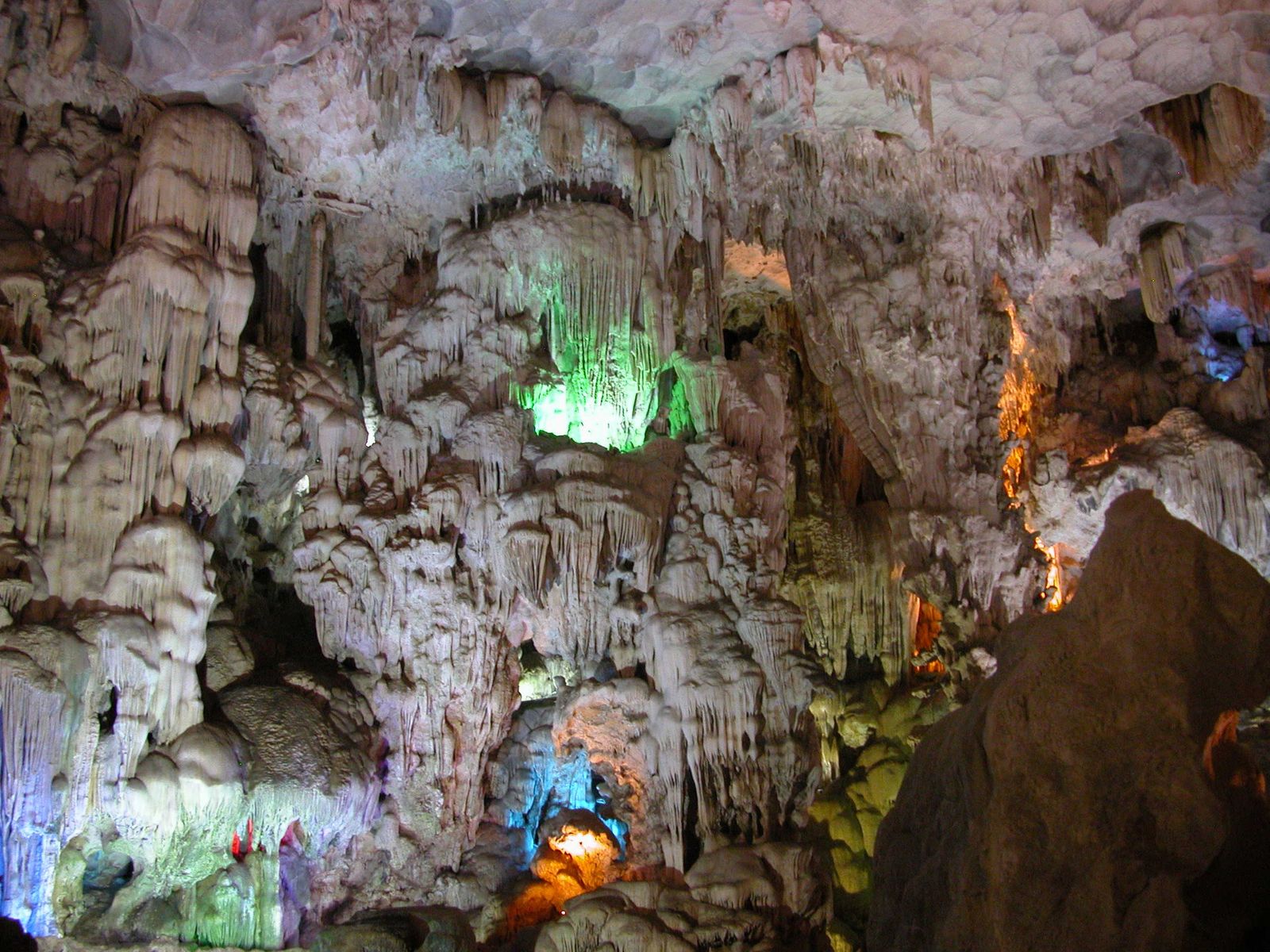
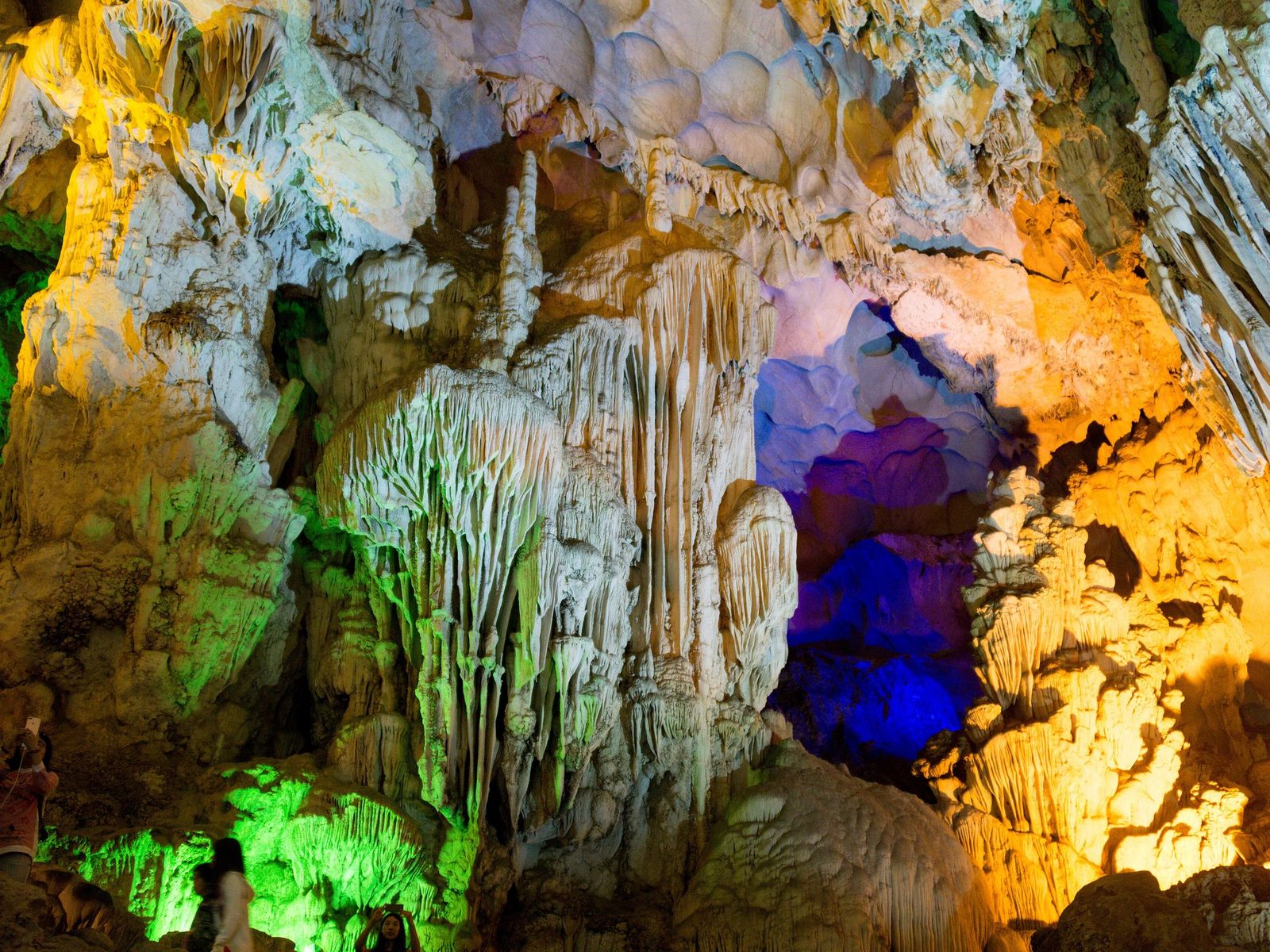
Động Thiên Cung (Thien Cung Cave, the Heavenly Palace Grotto) is on Đầu Gỗ island at the western end of the core zone, and boats on routes 1 and 5 stop there. It has three chambers and a floor of about 3,000 m², and on sunny days sunbeams pass through its Cổng Trời (Heaven’s Gate) at about 14:00 to 16:30.
The visit starts with a walk from the pier along the cliff, on a narrow path with separate lanes up and down that carries on to Đầu Gỗ Cave. The first chamber holds the Dragon and Phoenix stalagmites and Heaven’s Gate itself, two giant columns under a vault about 30 m high. The second has four pillars named Snake, Elephant, Turtle and Plant, with a figure called the Dragon King. In the third there is a freshwater pool, and an inner opening looks over an enclosed cove. The walk through the cave is about 190 m.
Its white formations gave the cave its name. In the legend the Dragon King’s son married Nàng Mây in the central chamber, in a wedding that went on for seven days and seven nights, and the pools are where she bathed her hundred children.
The Board dates the discovery to 1993, although an inscription on the wall dated 1901 suggests someone came earlier. The cave opened officially on 1 May 1998, the first in the bay to be fitted out at scale with stairs, corridors and lighting, and it received over 710,000 visits in 2024.
Hang Đầu Gỗ (Dau Go Cave, the Wooden Stakes Cave) is on the same island, about 300 m east of Thiên Cung, and a stairway of 90 steps leads from the shore to its starfish-shaped entrance. Its three chambers cover about 5,000 m².
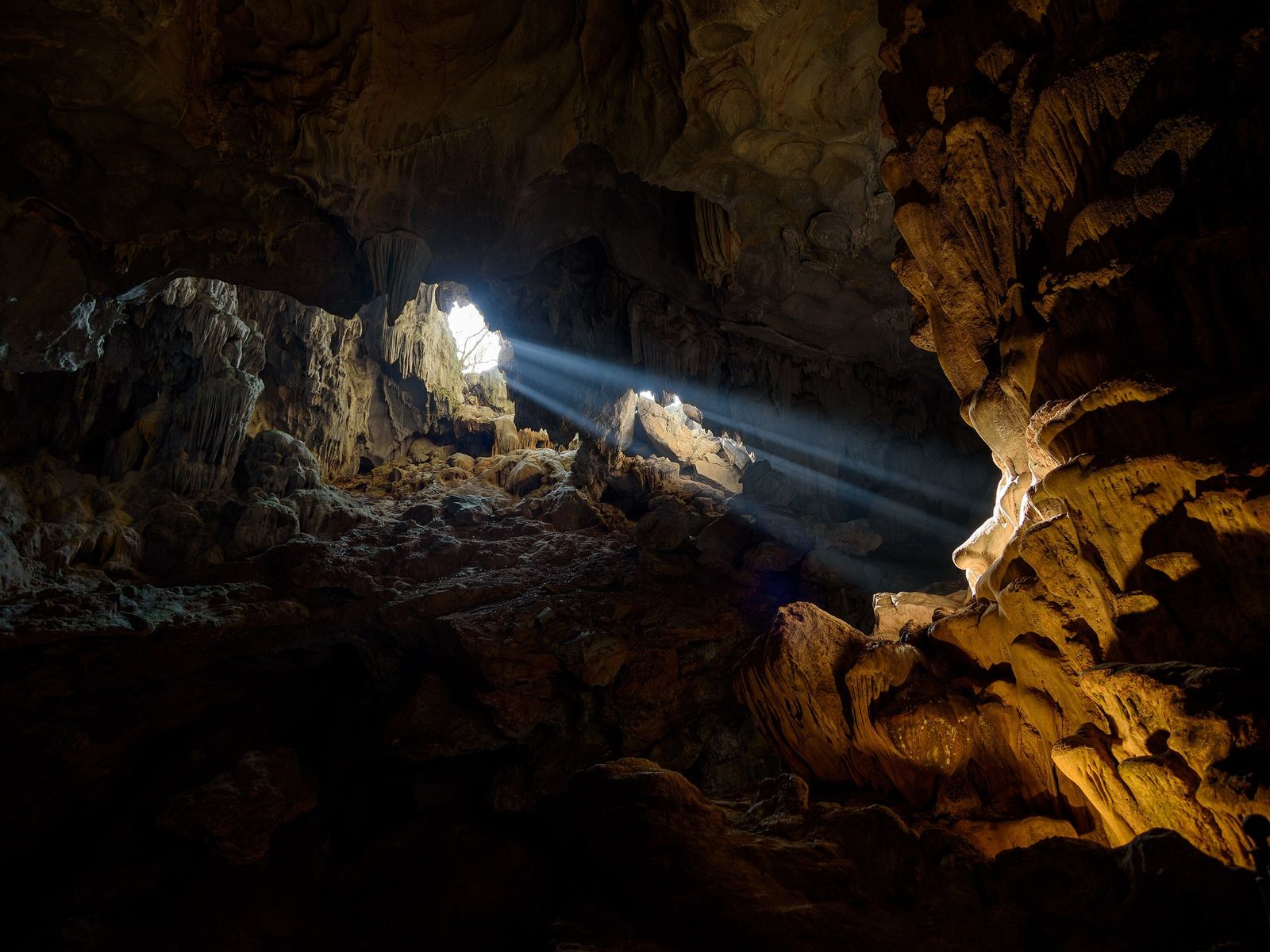
The first chamber has a vault more than 20 m high, lit by daylight, with moss, ferns and orchids growing on the rock. The second is dimmer. The third holds a freshwater well that keeps its water all year and a column more than 20 m tall. Inside, the temperature stays between 20 and 22 °C, and a lit wooden walkway of about 500 m was finished on 2 September 1999.
Three traditions explain the name. One says soldiers of the Trần dynasty hid wooden stakes here for the battle of Bạch Đằng in 1288, so the cave was first Giấu Gỗ, “hidden wood”. Another says fishermen mended their boats here and left the ends of the timber behind, and a third says the island looks like the head of a log. The stakes story ties the cave to the bay’s most famous battle, told on the history and geology page.
On 2 May 1918 King Khải Định came with Governor-General Albert Sarraut, named the cave Ngũ Sắc Tường Vân and left a twelve-line poem on a stele more than a metre tall, on the left wall at the entrance. Hồ Chí Minh climbed the 90 steps in October 1957.
Hang Đầu GỗA beam of daylight crosses a dark chamber of Đầu Gỗ Cave from an opening above.Photo: Mustang Joe, CC0
Hang Đầu GỗRowing boats of visitors wait on green water beyond the mouth of Đầu Gỗ Cave, seen from inside.Photo: Mustang Joe, CC0
Sung Sot Cave, the largest
Hang Sửng Sốt (Sung Sot Cave, “Surprise Cave”) is the largest cave open to visitors, about 10,000 m² on Bồ Hòn island, and the busiest, with about 1.857 million visits in 2024. It is a stop on route 2, and its chambers, steps and history have their own page: Sung Sot Cave, chamber by chamber.
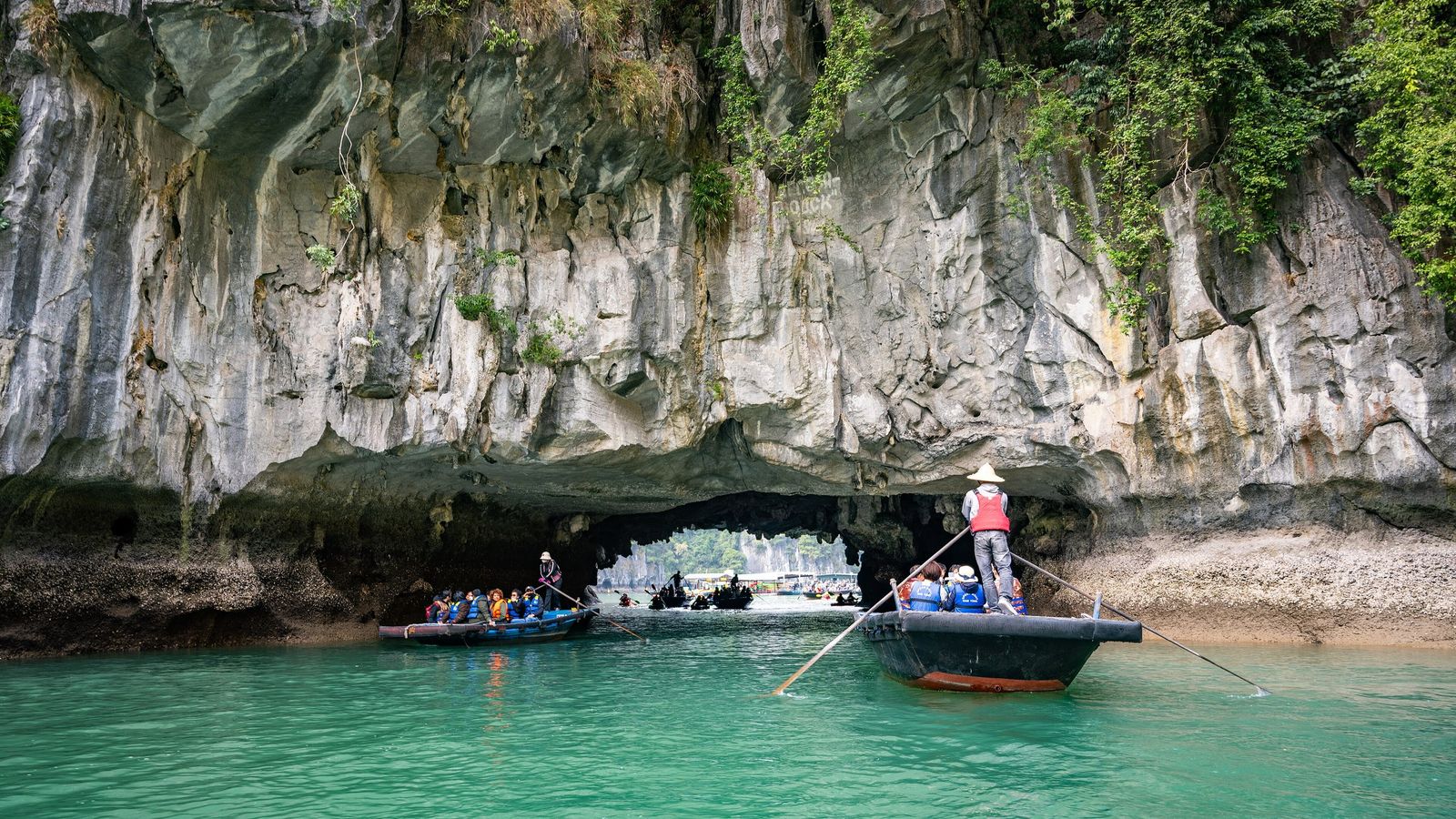
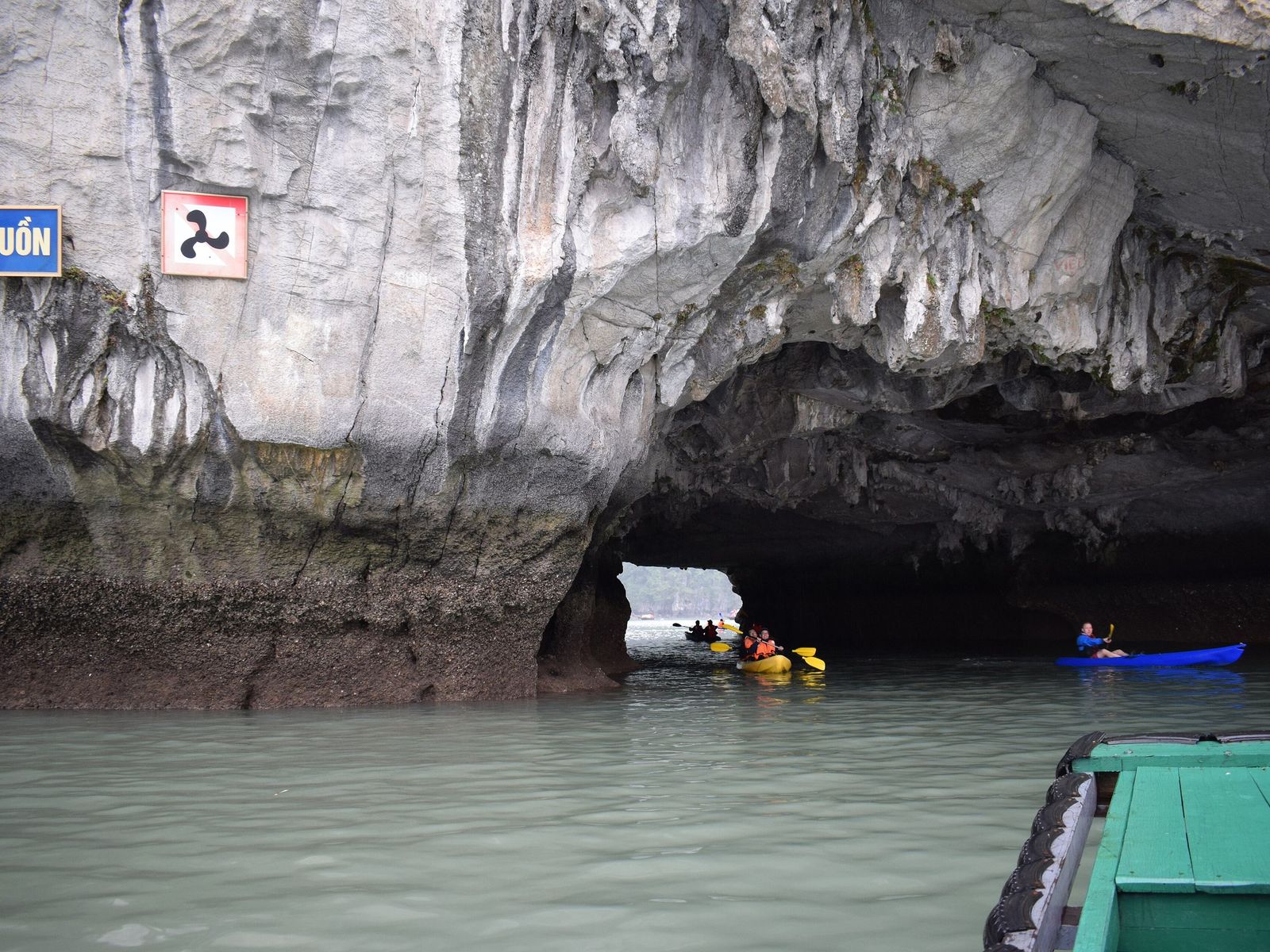
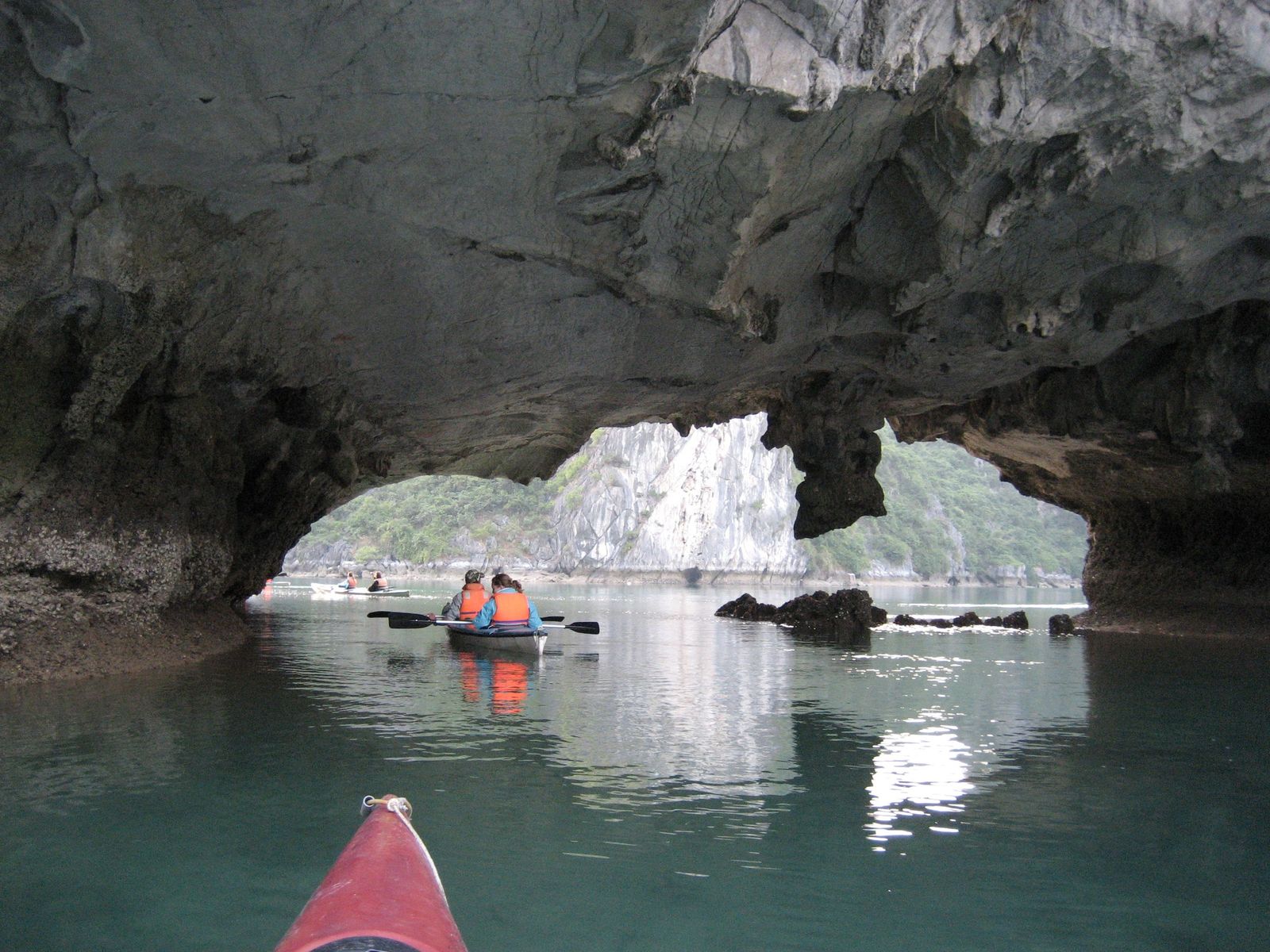
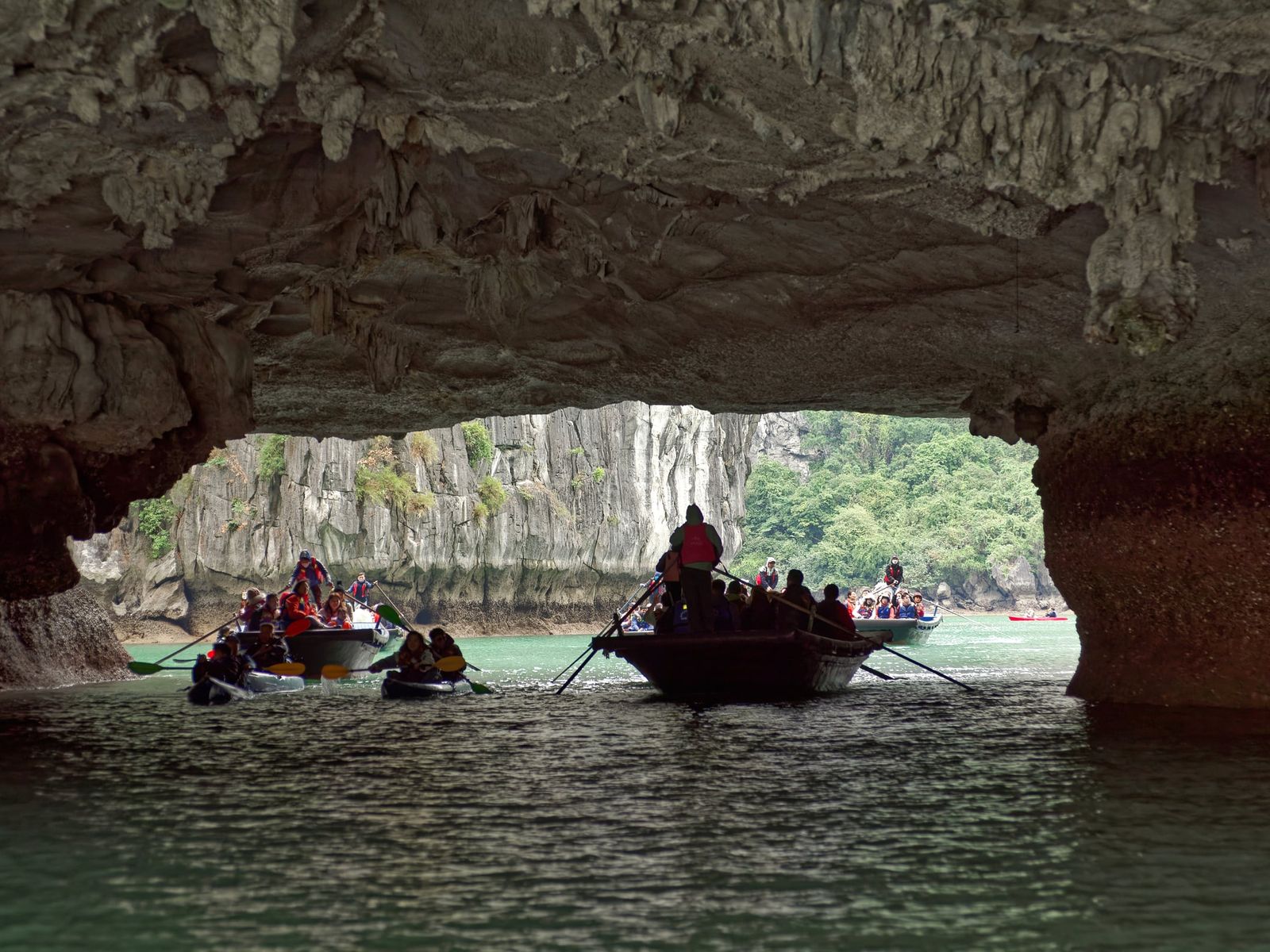
Hang Luồn (Luon Cave) is a sea tunnel with a flooded floor that opens into a lagoon ringed by cliffs. Visitors go in only by bamboo rowing boat or kayak, and it is a stop on route 2.
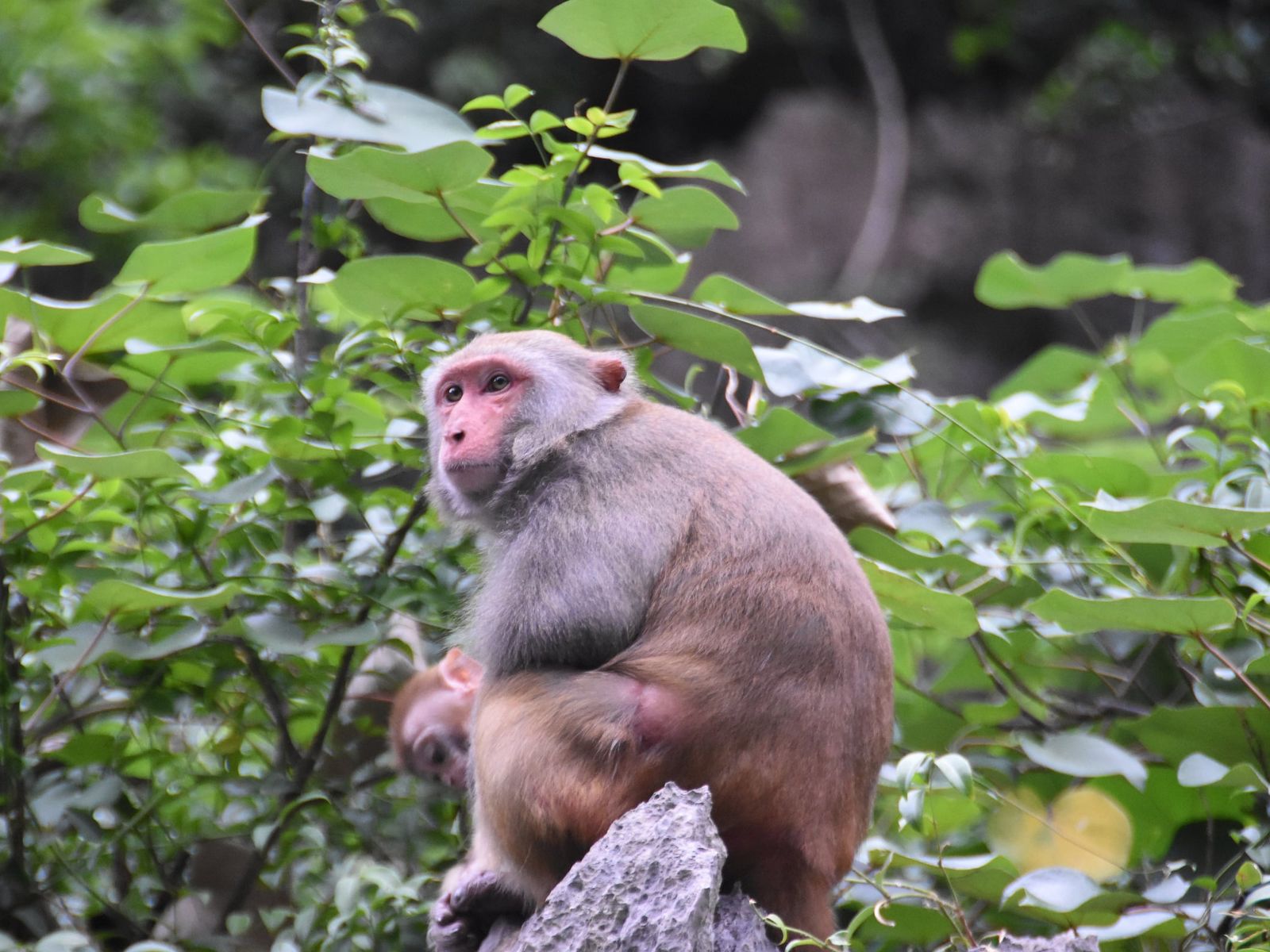
Luồn means to slip through, and at high tide visitors duck down in the boat to pass under the rock. Several hundred rhesus macaques live in troops around the lagoon, among Ha Long cycads, palms and ginger plants. On the lagoon walls, 3 to 4 m above the water, you can see shell layers left by people of the Soi Nhụ culture.
The boat or kayak is paid for on the spot, to the licensed operator, and is not part of the sightseeing ticket. The Board’s price list, last updated on 9 November 2024, gives 30,000 VND per person for a rowing boat, 50,000 VND per trip for a two-person kayak and 100,000 VND per person for 15 minutes on a speedboat. Kayaking elsewhere in the bay is covered on the things to do page.
Luồn was the busiest site on the bay in 2012, with 1,978,412 visits that year. No later count has been published, but the press still names it with Sửng Sốt and Thiên Cung among the caves that overflow at summer peaks.
Hang LuồnThe bow of a kayak points at the rock arch of Luồn Cave, with a boat of visitors beneath it.Photo: Arian Zwegers, CC BY 2.0
Hang LuồnLooking out through the Luồn Cave tunnel, a rowing boat with a standing rower and visitors in life jackets approaches among kayaks on green water.Photo: Jakub Hałun, CC BY 4.0
Route 2 also stops at Động Mê Cung (Me Cung Cave), Hang Trống (Trong Cave), Hang Trinh Nữ (Trinh Nu Cave) and Hang Hồ Động Tiên (Ho Dong Tien Cave). Route 3 stops at Hang Tiên Ông (Tien Ong Cave) and route 4 at Hang Cỏ (Co Cave), and the two of these with 2024 counts are far quieter than Sửng Sốt: Tiên Ông had over 7,400 visits and Hang Cỏ over 74,000.
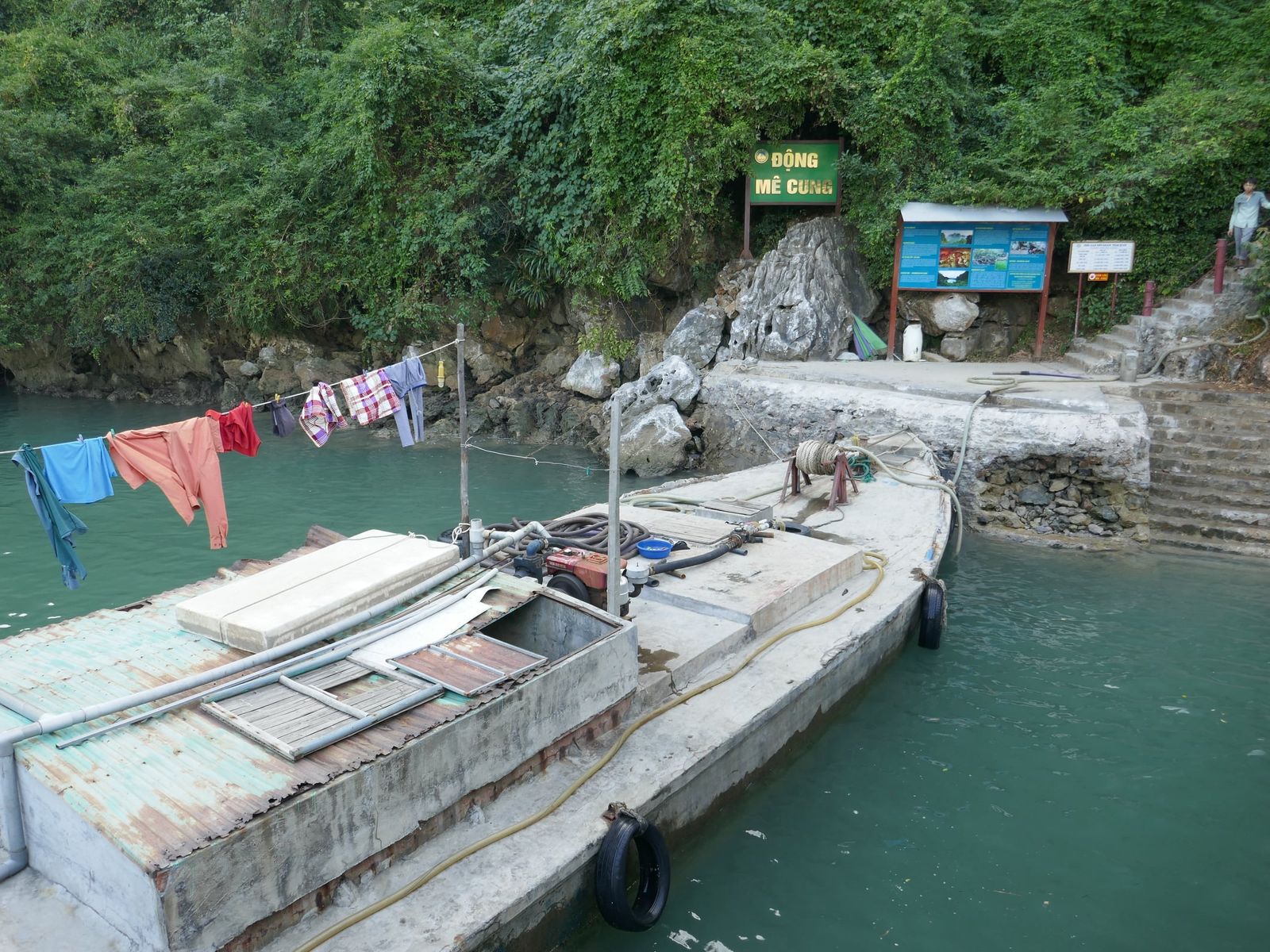
Động Mê CungA moored boat with clothes on a line beside it lies at the landing below the green name board of Mê Cung Cave, with stone steps climbing the wooded slope.Photo: Ji-Elle, CC BY-SA 4.0
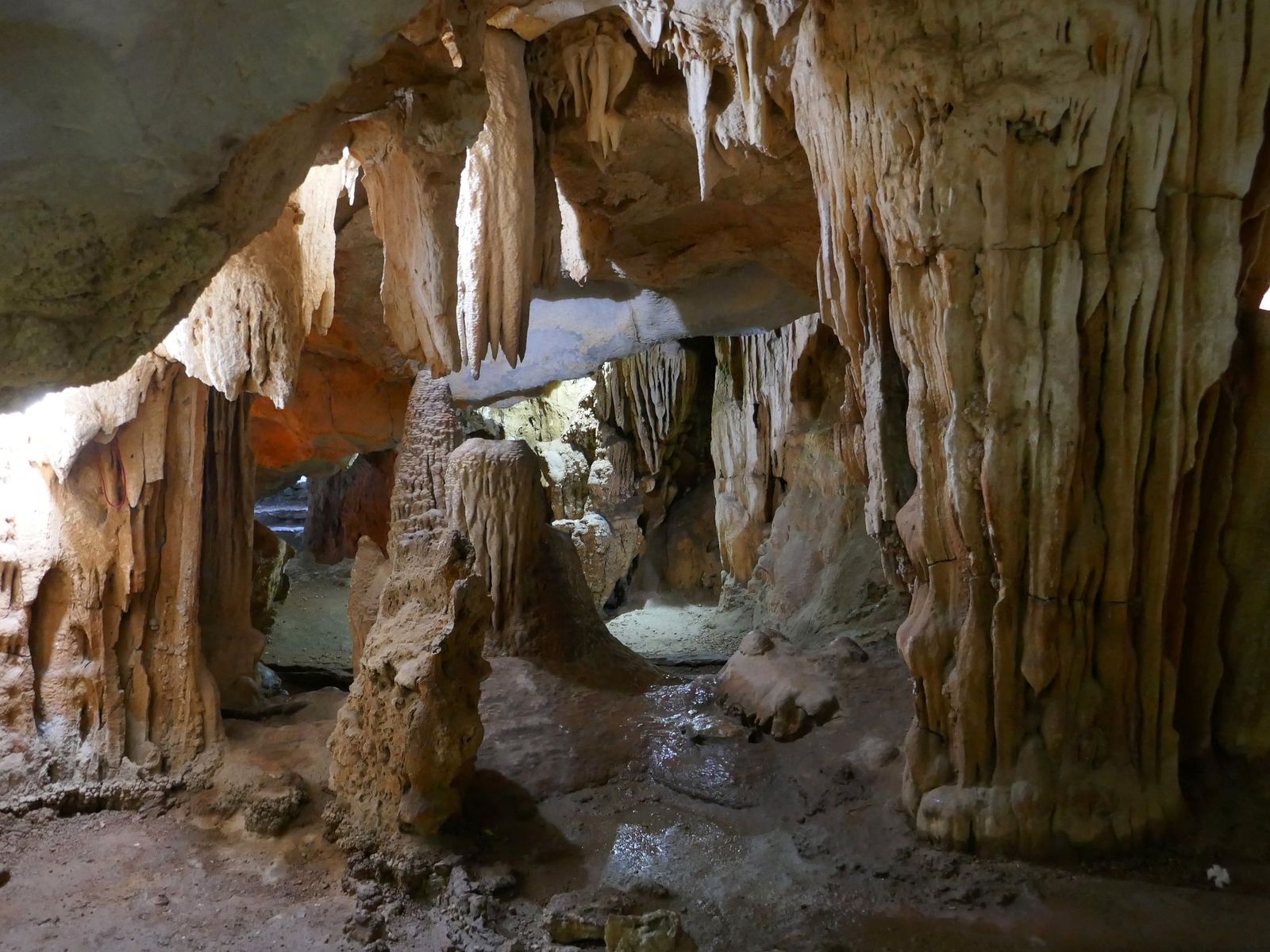
Động Mê CungRibbed stalactites and columns in cream and orange rock frame passages that open to daylight inside Mê Cung Cave.Photo: Ji-Elle, CC BY-SA 4.0
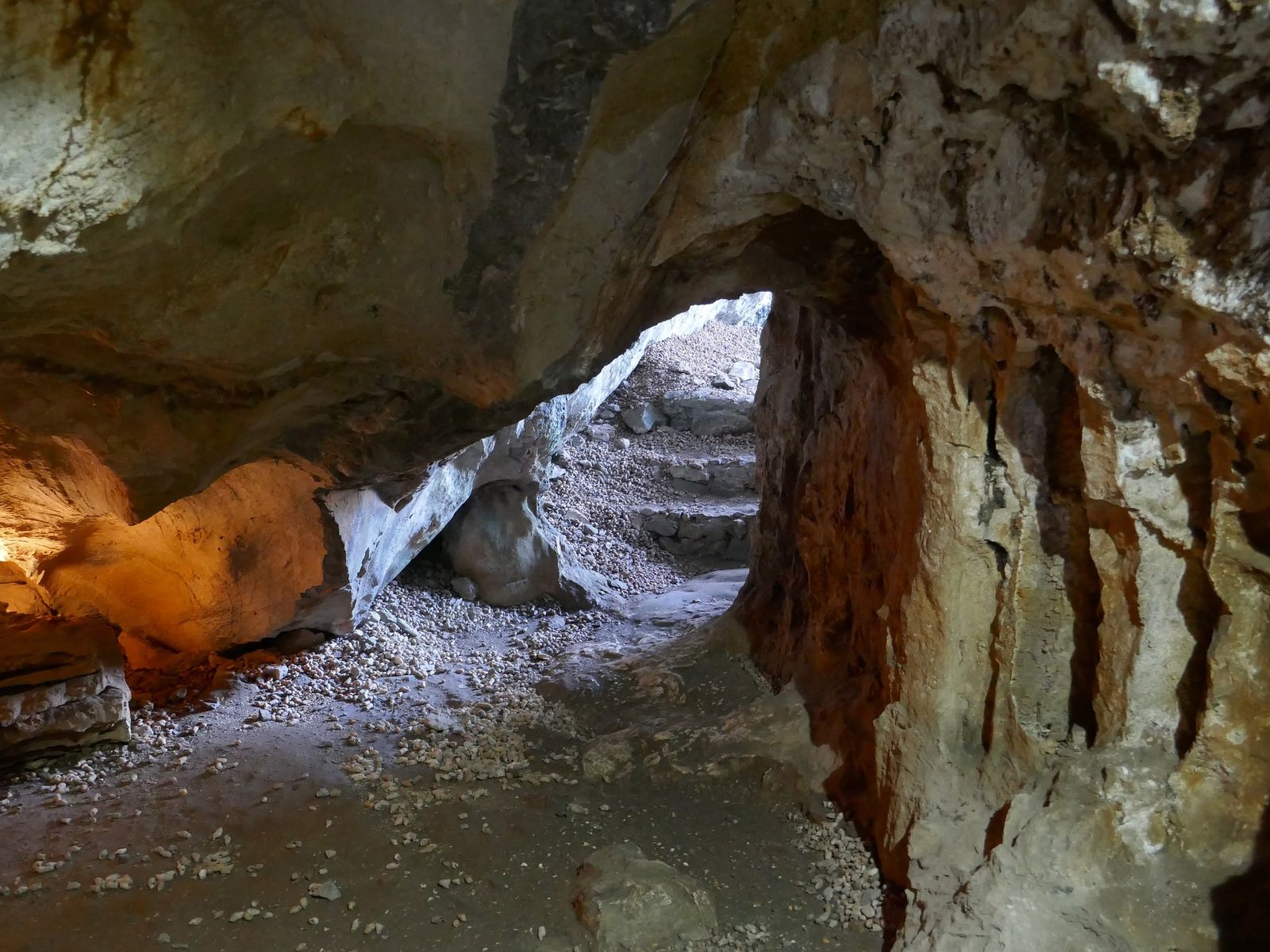
Động Mê CungA path of pale gravel and flat stone steps climbs through a low rock arch in Mê Cung Cave, with a small light at the lower left.Photo: Ji-Elle, CC BY-SA 4.0
Động Mê Cung(Me Cung Cave, the Maze Cave)
VHL2
The last stop of the route 2 day trip, on Lờm Bò island about 2 km south-west of Ti Tốp. The entrance is about 25 m up, and four main chambers are joined by slits one person wide along nearly 100 m of corridor, with an enclosed lagoon behind and below. People of the Soi Nhụ culture lived here from about 18,000 to 7,000 years ago, leaving a shell midden 2 to 3 m thick at the entrance, and a polished stone spear point about 30 cm long found in 2008 has been called the longest found in Vietnam. It opens at 08:00.
Hang Trinh Nữ(Trinh Nu Cave, the Virgin Cave)
VHL2
A cave of about 600 m² on the east side of Bồ Hòn island, with three chambers, two entrances and a small beach. A stalagmite at the entrance looks like a girl with long hair reaching towards the sea. A layer of the Hạ Long culture about 4,500 years old lies inside, and pottery from a harbour of the 14th to 16th centuries lies at the waterline.
Hang Trống(Trong Cave, the Drum Cave)
VHL2
Across an inlet 700 to 800 m wide from Trinh Nữ, a cave of about 300 m² with a tall stalagmite like a young man looking out to sea. Wind through slits in the rock makes a sound like a drum, which gave the cave its name.
Hang Hồ Động Tiên(Ho Dong Tien Cave, the Fairy Lake Cave)
VHL2
A cave at the foot of a cliff on the east side of Bồ Hòn, 0 to 5 m above the sea, with three chambers in about 650 m² and old cave floors hanging on the walls as records of past sea levels. Look for the stalagmite called Chén Ngọc (Jade Cup). The third chamber opens onto Áng Tiên, a saltwater lagoon where a legend says fairies bathed. That last chamber gets no daylight, so the official advice is to bring a small torch.
Hang Tiên Ông(Tien Ong Cave, the Old Sage Cave)
VHL3
In the Hang Trai island group, about 18 km from Tuần Châu, and mostly reached by overnight cruises. Soi Nhụ people lived here about 10,000 to 8,000 years ago, and since 2017 the cave has held the bay’s only on-site archaeological exhibition, with bilingual panels, tools, layers of food waste and two dig pits left open. It received over 7,400 visits in 2024 and opens at 08:00.
Hang Cỏ(Co Cave, also called Thiên Cảnh Sơn)
VHL4
A small cave about 40 m above sea level, reached by about 70 stone steps, with a narrow entrance, a low ceiling, light falling through cracks in the roof and a viewpoint over the bay at the back. A white-sand beach lies below. In July 2025 the press reported poor lighting, bottlenecks and damaged steps, and upgrades were planned as of December 2025. It had over 74,000 visits in 2024.
Hang Bồ Nâu(Bo Nau Cave, the Pelican Cave)
VHL2
Under 1 km from Sửng Sốt. On the official day itinerary the boat passes without landing, which is enough to see its shell-shaped arch, 50 to 70 m wide. Pelicans once wintered here, and the name Bồ Nông drifted to Bồ Nâu. In 1958 Nguyễn Duy Kiên photographed a red bat-wing sail from inside this cave, a picture regarded as the bay’s first notable art photograph.
Hang Ba Hang(Ba Hang Caves, the Three Caves)
VHL1VHL5
Three caves cut at sea level, linking saltwater lakes, visited from routes 1 and 5 by local bamboo rowing boat or kayak, with fish-farm rafts beyond. Two of the caves served fishermen as storm shelters, and the site was used as a location for Kong: Skull Island. The Board’s 2024 price list gives 40,000 VND per person for either boat.
Hang Thầy(Thay Cave)
VHL4
Near Cống Đỏ on route 4, about 23 km from Tuần Châu: one main chamber 160 m long with river scallops on its roof, a 70 m beach and a coral-reef conservation zone at the entrance. Whether visitors are admitted now has not been confirmed.
Động Cặp La(Cap La Cave)
VHL4
A newly discovered cave on Cặp La island, about 25 km from Tuần Châu, with an entrance 20 to 30 m up and a floor of about 3,000 m². As of October 2026 the Board’s route 4 page says its facilities are still being developed.
One more cave appears in older guides: Động Thiên Long (Thien Long Cave), about 1 km east of Đầu Gỗ, was found in July 1994 and is kept as an archaeological site that visitors cannot enter.
Tips for visiting the caves
Wear shoes with good grip. No official source describes step-free access to any cave, and Đầu Gỗ, Sửng Sốt and Hang Cỏ involve roughly 90, 60 and 70 steps. Opening hours change on 16 April and 1 November, a ban on eating and drinking inside the caves was reported in 2016, and a small torch helps in the last chamber of Hồ Động Tiên.
Leave the formations alone. Touching has darkened and polished some formations in the busiest caves, and the Board’s rules forbid breaking stalactites or carving and drawing on the rock.
Eat on the boat. A ban on eating and drinking in the caves was reported in 2016, and in 2025 Quảng Ninh said dining in caves is not licensed.
Leave single-use plastic behind. Bottles, cups, straws and bags have been banned on the bay since 1 September 2019, and the ticket gates check.
Expect crowds in summer and on holidays. No source gives a quiet time of day for any cave. What is known is that Thiên Cung, Sửng Sốt and Luồn overflow at summer peaks and on public holidays.
Buy tickets inside the port. The Board sells sightseeing tickets at its counters in the two port terminals and advises against touts outside and vendor boats that come alongside.
Watch the weather. When a storm approaches the authorities stop all departures, and no cave can be reached until they lift the stop.
Visiting hours of the caves on the official routes, from the Board's visiting-hours page (updated 6 November 2024). Checked October 2026.
Caves and season
Open
Thiên Cung, Đầu Gỗ, Ba Hang, Sửng Sốt, Ti Tốp and Luồn, 16 April to 31 October
07:30 to 17:30
Thiên Cung, Đầu Gỗ, Ba Hang, Sửng Sốt, Ti Tốp and Luồn, 1 November to 15 April
07:30 to 17:00
Mê Cung, Tiên Ông and the Cửa Vạn centre (closed to visits), summer
08:00 to 17:30
Mê Cung, Tiên Ông and the Cửa Vạn centre (closed to visits), winter
08:00 to 17:00
Hang Cỏ (Thiên Cảnh Sơn) and Vung Viêng, summer
07:30 to 17:00
Hang Cỏ (Thiên Cảnh Sơn) and Vung Viêng, winter
08:00 to 16:45
How the caves formed
The caves are of three kinds. Old phreatic caves were dissolved underground and now hang high in the cliffs, like Sửng Sốt, Thiên Cung and Đầu Gỗ. Karst-foot caves were cut at the base of cliffs, like Trinh Nữ and Tiên Ông. Marine notch caves were cut at sea level, like Luồn and Ba Hang.
All of them sit in limestone about 1,000 m thick and roughly 350 to 260 million years old. A notch, hàm ếch biển or “frog’s mouth” in Vietnamese, is a groove cut into a cliff at sea level by dissolving seawater and waves, and in places it deepens into an arch or a tunnel like Luồn. When the sea floods a sinkhole it becomes a saltwater lake, called tùng or áng locally. The rock is ancient, but the seascape is young: since the last ice age, about 20,000 years ago, the sea has risen by more than 125 m. Thiên Cung itself formed between about 781,000 and 11,700 years ago. The full story of the rock, the sea and the people is on the history and geology page.
Questions visitors ask
How many caves are there in Ha Long Bay?
The Board counts about 70 caves in the core zone, 12 of them in tourism use. Which of them you reach depends on the official route your boat follows.
Do you need a ticket for each cave?
No. One route ticket covers every sight on the itinerary. The adult fee is 250,000 VND on routes 1, 2 and 5 and 200,000 VND on routes 3 and 4 (checked October 2026).
Which caves can you kayak into?
Hang Luồn and Hang Ba Hang can be entered by bamboo rowing boat or kayak, and the Hồ Ba Hầm lagoons on route 3 by small boat or kayak at low tide. Kayaking is allowed only at licensed points with contracted operators, and you pay the operator.
Which cave is the most crowded?
Sửng Sốt, with about 1.857 million visits in 2024 against over 710,000 at Thiên Cung. Thiên Cung, Sửng Sốt and Luồn all become overloaded at summer peaks and on holidays.
Is Thiên Cung larger than Sửng Sốt?
No. Sửng Sốt covers about 10,000 m² and is the largest cave open to visitors, while the Board gives Thiên Cung a floor of about 3,000 m². A larger figure for Thiên Cung circulates online, but the Board’s 2025 and 2026 pages give 3,000 m².
Can wheelchair users visit the caves?
No official source describes step-free access to any cave, pier or cave path, and every cave with a published count involves dozens of steps. Ask the boat operator about access before you pay.
Sources
Facts checked
Báo Quảng Ninh, Khám phá các hang động trên Vịnh Hạ Long, 30 December 2025.
Ha Long Bay - Yen Tu World Heritage Management Board, Các hang động trên vịnh Hạ Long, 12 January 2026.
Ha Long Bay - Yen Tu World Heritage Management Board, Place pages for Thiên Cung, Đầu Gỗ, Sửng Sốt, Luồn, Mê Cung, Trinh Nữ, Trống, Tiên Ông, Bồ Nâu and Hang Cỏ.
Ha Long Bay - Yen Tu World Heritage Management Board, Articles on Thiên Cung (19 March and 29 July 2026), Đầu Gỗ (21 March, 19 May, 18 July and 4 August 2026), Hồ Động Tiên (6 April 2026), Ba Hang (11 March 2026) and Bồ Nâu (30 December 2025).
Ha Long Bay - Yen Tu World Heritage Management Board, Thời gian đón khách tham quan (visiting hours), updated 6 November 2024.
Ha Long Bay - Yen Tu World Heritage Management Board, Mức phí tham quan vịnh Hạ Long (sightseeing fees), 31 March 2025.
Ha Long Bay - Yen Tu World Heritage Management Board, Dịch vụ chèo đò, chèo kayak (rowing and kayak price list), updated 9 November 2024.
Ha Long Bay - Yen Tu World Heritage Management Board, Lưu ý khi tham quan vịnh Hạ Long (visitor rules), 6 September 2024.
Quảng Ninh Provincial People's Committee, Decision 2119/QĐ-UBND on the Ha Long Bay and Bái Tử Long itineraries, 19 July 2024.
Vietnam National Authority of Tourism, Destination pages for Đầu Gỗ, Thiên Cung, Mê Cung, Trinh Nữ, Trống and Bồ Nâu.
Báo Quảng Ninh, Article on King Khải Định's 1918 visit and the stele at Hang Đầu Gỗ, 28 August 2019.
Pháp Luật TP.HCM (PLO), Report on the steps at Hang Sửng Sốt, 1 August 2019.
Báo Quảng Ninh, Report on lighting, bottlenecks and steps at Hang Cỏ, 6 July 2025.
Tuổi Trẻ, Quảng Ninh: Chưa cấp phép dịch vụ ăn uống trong hang động, 12 March 2025.
IUCN, World Heritage technical evaluation of Ha Long Bay (document 154005), 2000.
Prices, fees and timetables change. Figures on this page were checked in the month shown on the postmark.